Introduction
OG Network (also known as 0G Network) is an AI-native Layer-1 blockchain designed specifically for decentralized artificial intelligence applications. Unlike general-purpose blockchains, OG Network focuses on providing scalable compute, storage, data availability, and verifiable AI inference as a unified on-chain system.
This guide explains what OG Network is, why users are interested in it, what risks exist, and most importantly, how users can safely access this Network using cross-chain infrastructure.
What Is the OG Network?
OG Network is an AI-native Layer-1 blockchain built as a decentralized AI operating system (often referred to as a DeAIOS). Its core goal is to make AI a public, verifiable, and censorship-resistant resource, rather than something controlled by centralized cloud providers or large technology companies.
Unlike general-purpose blockchains, OG Network is purpose-built for AI workloads, with infrastructure designed to support on-chain AI inference, scalable data storage, and high-throughput computation. It remains EVM-compatible, allowing developers to use familiar smart contract tools while benefiting from low latency and high performance. OG Network positions itself as the “Artificial Intelligence Layer” for Web3, enabling AI, gaming, and DeFi applications to run transparently on-chain.
The network is developed by 0G Labs, with decentralization and long-term governance supported by the 0G Foundation. Key founders include Michael Heinrich (CEO), Ming Wu (CTO), Fan Long (CSSO), and Thomas Yao (CBO), combining expertise in distributed systems, security, AI, and blockchain infrastructure.
Why Are Users Interested in OG Network?
Interest in this Network is driven by a broader shift toward making AI infrastructure more open, verifiable, and accessible, rather than controlled by a small number of centralized providers.
For developers, this Network offers a way to build AI-native applications on public infrastructure, where data, models, and computation can be accessed without relying on closed cloud platforms. By treating AI as a public good, the network aims to reduce dependency on centralized providers such as traditional cloud services, while lowering costs for computation and data usage.
For AI agents and autonomous systems, OG Network enables verifiable AI inference, allowing outputs and decision-making processes to be checked on-chain. This is especially important for applications where transparency, trust, and reproducibility matter.
For Web3 users, this Network brings AI closer to blockchain-native use cases, such as intelligent NFTs, onchain agents, gaming logic, and advanced DeFi primitives. By unifying data, compute, and blockchain logic into a single modular system, the network addresses long-standing fragmentation issues in decentralized AI development.
How Does OG Network Work?
OG Network uses a modular architecture, where different components handle specific AI-related tasks. This allows the network to scale without overloading a single blockchain layer.
Core components (simplified):
- OG Chain
The base Layer-1 blockchain is responsible for execution, settlement, and coordination. It is EVM-compatible and optimized for AI workloads. - Compute Network
A decentralized GPU marketplace that enables AI inference and fine-tuning, with results verified using cryptographic proofs. - Storage Layer
High-performance decentralized storage for large AI datasets and models, supporting both immutable and mutable data. - Data Availability (DA) Layer
A scalable data layer ensuring fast and verifiable access to AI-related data for agents, rollups, and applications.
This separation allows OG Network to support AI-scale throughput that traditional blockchains struggle with.
What is the $0G Token Used For?
The $0G token is the native utility token of OG Network.
It is used for:
- Paying network transaction fees
- Staking and validator participation
- Governance and protocol decisions
- Payments for AI compute, storage, and data services
- Incentives for ecosystem participants and alignment nodes
Token supply
- Fixed total supply (1 billion)
- Majority allocated to community, ecosystem growth, and incentives
- Team and investor allocations vest over multiple years
The token design aims to balance network utility with long-term sustainability, rather than short-term speculation.
OG Network Ecosystem and Partnerships
OG Network has built a large ecosystem focused on decentralized AI infrastructure.
Notable ecosystem signals include:
- Hundreds of integrations across AI, gaming, and DeFi projects
- Support for AI agents, zkML, and verifiable inference frameworks
- Partnerships and integrations with infrastructure and data providers
- Developer tooling via SDKs, documentation, testnets, and builder hubs
These signals indicate active ecosystem development, though real-world adoption is still evolving.
What Risks Should Users Know About OG Network?
Despite its technical ambitions, this Network carries important risks, especially for non-technical users.
Key considerations:
- Early-stage risk: AI-native blockchains are still experimental
- Ecosystem maturity: Fewer production applications than established L1s
- Complexity risk: AI, storage, and compute introduce new failure modes
- Token risk: Supply unlocks, and incentives may impact market dynamics
- Cross-chain risk: Accessing the OG Network often requires bridging assets
Understanding these risks is essential before interacting with the network.
How Do Users Access the OG Network?
OG Network is a separate Layer-1 blockchain, which means users cannot simply send assets from Ethereum or other networks directly.
To access this Network, users typically need to:
- Swap or bridge assets from another blockchain
- Use a compatible self-custodial wallet
- Acquire $0G tokens for fees or ecosystem participation
This is where cross-chain infrastructure becomes necessary.
How to Bridge to the OG Network Safely Using RocketX Exchange
Accessing this Network requires cross-chain routing, as the OG Network operates as a separate Layer-1 blockchain. Assets cannot be sent directly from other chains and must be moved using a bridge or cross-chain swap.
The safest approach is to use non-custodial cross-chain routing, which allows users to retain full control of their funds throughout the process.
RocketX Exchange is a non-custodial cross-chain aggregator designed to help users access networks like OG Network securely and efficiently.
Step-by-Step: Bridge to OG Network on RocketX
Step 1: Open RocketX and connect your wallet
Visit app.rocketx.exchange and connect your wallet based on where your funds are currently stored. RocketX supports major EVM and non-EVM wallets, and your assets remain in your wallet at all times.
Step 2: Select the source network and token
Choose the blockchain where your funds currently reside, such as Ethereum, BNB Chain, Arbitrum, Base, Polygon, or other supported networks. Select the token you want to bridge (for example, USDT, USDC, or ETH) and enter the amount.
Step 3: Select OG Network as the destination
In the destination field, choose OG Network (0G) and the supported destination token. RocketX automatically finds the most efficient cross-chain route by comparing liquidity across hundreds of exchanges and bridges.
Step 4: Enter the recipient wallet address
Paste your OG Network–compatible wallet address to ensure funds are delivered directly to your wallet. Double-check the address before proceeding, as cross-chain transactions are irreversible.
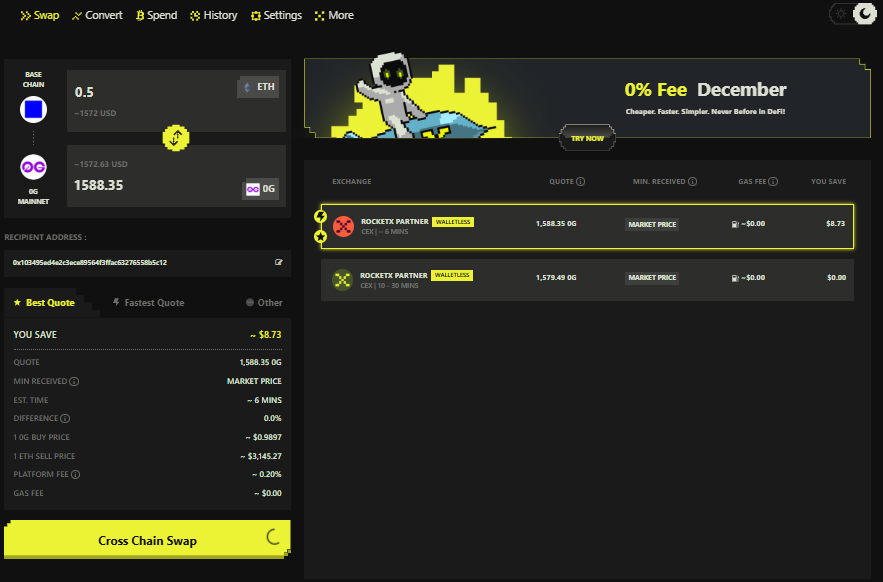
Step 5: Review details and confirm the swap
Review the estimated output, fees, and routing details. Click Cross-Chain Swap and confirm the transaction in your wallet.
Step 6: Receive funds on OG Network
Once the process is completed, your assets arrive directly in your wallet with no deposits, withdrawals, or custody risk involved.
Wallet Setup, Fees, and Common Mistakes
Before accessing this Network:
- Ensure your wallet supports EVM networks
- Add OG Network RPC details if required
- Keep gas tokens for transactions
Common mistakes to avoid:
- Sending assets directly without a bridge
- Using centralized exchange deposit addresses
- Bridging full balances without testing
- Interacting with unofficial or fake URLs
Most losses occur due to user-side errors, not protocol failures.
Frequently Asked Questions (FAQs)
What makes OG Network different from Ethereum?
This Network is designed specifically for AI workloads, while Ethereum is general-purpose.
Is OG Network live?
Yes. The Network has completed the mainnet launch and continues ecosystem expansion.
What is the $0G token used for?
Gas fees, staking, governance, and payments for AI services.
Is OG Network safe to use?
It carries a higher risk due to complexity and early-stage adoption.
Why do I need a bridge to access OG Network?
Because this Network is a separate Layer-1 blockchain.
Is RocketX custodial?
No. RocketX does not hold user funds at any stage.
Final Thoughts
OG Network represents an ambitious attempt to build a decentralized, verifiable AI infrastructure at blockchain scale. Its modular design and AI-native focus differentiate it from traditional Layer-1 networks, but complexity and early-stage risks remain.
For users, the safest approach is:
- Learn the fundamentals
- Understand the risks
- Use non-custodial cross-chain tools
- Start with small test transactions
RocketX Exchange provides a transparent, infrastructure-level path for users who want to access this Network while maintaining self-custody.