Executive Summary
Humanity Protocol is a zkEVM Layer 2 blockchain built on Polygon’s Chain Development Kit, introducing the world’s first decentralized Proof-of-Humanity (PoH) consensus mechanism. The protocol enables users to cryptographically prove their unique identity through non-invasive palm recognition technology while maintaining complete privacy through zero-knowledge proofs. Unlike centralized government databases, Humanity Protocol puts individuals in control of their biometric and identity data via tamper-proof blockchain infrastructure, ensuring privacy, security, and resistance to censorship. Humanity Protocol represents a revolutionary approach to solving bot attacks, Sybil resistance, and identity verification in the Web3 ecosystem.
What is Humanity Protocol? Understanding the Basics
Humanity Protocol is solving one of the most critical challenges faced by Web3 today: verifying that participants are real, unique humans without compromising their privacy. Traditional identity systems require users to surrender personal data to centralized authorities, creating privacy risks and single points of failure. Humanity Protocol disrupts this model by creating a Self-Sovereign Identity (SSI) framework where users maintain complete control over their digital credentials.
The protocol operates as a comprehensive identity verification ecosystem that goes beyond simple human verification. It creates an open identity graph supporting verifiable credentials across a range of attributes, from personally identifiable information (PII) to education, employment, and event participation. This extensibility allows users to selectively prove aspects of their identity in a privacy-preserving, decentralized manner.
Core Technology: How Proof-of-Humanity Works
At the heart of Humanity Protocol lies its innovative proof-of-humanity consensus mechanism, which represents a fundamental departure from traditional blockchain consensus models like proof-of-work or proof-of-stake. Instead of validating transactions through computational power or token holdings, PoH validates the uniqueness and humanity of network participants.
The verification process uses palm recognition technology—a non-invasive biometric method that scans the unique patterns of palm prints and palm veins. Unlike iris scanning (used by competitors like Worldcoin), palm recognition is less invasive and raises fewer privacy concerns. The biometric data is immediately converted into cryptographic hashes using zero-knowledge proofs, meaning no raw personal data is ever stored or shared on-chain.
Technical Architecture:
- zkEVM Layer 2: Built on Polygon Chain Development Kit (CDK), providing Ethereum compatibility with enhanced privacy
- Zero-Knowledge Proofs: Ensures biometric information remains private while proving authenticity
- zkTLS Technology: Launched in August 2025, enables linking Web2 credentials with Web3 services
- Decentralized Storage: User data is distributed across the network, eliminating central points of failure
- Smart Contract Integration: Fully compatible with Ethereum Virtual Machine (EVM) applications
The Three-Phase Verification System
Humanity Protocol implements a progressive verification system designed to balance accessibility with security:
Phase 1 – Human ID Reservation (Currently Live): Users can reserve their unique Human ID on the blockchain, claiming their permanent digital identity. This phase requires minimal technical knowledge and serves as the entry point to the ecosystem.
Phase 2 – Mobile Palm Print Verification (Rolling Out): Users verify their identity through mobile applications that scan palm prints. This phase is being deployed in batches to ensure system stability and user experience quality. The mobile-based approach makes verification accessible to billions of smartphone users globally.
Phase 3 – Full Palm Vein Verification (Upcoming): Advanced Humanity Scanners utilizing specialized hardware will provide the highest level of verification by scanning palm vein patterns. These scanners are initially available at select crypto events and will be distributed more broadly throughout 2026, creating revenue opportunities for scanner operators while expanding network verification infrastructure.
H Token: Economics, Distribution, and the Revolutionary Fairdrop Model
Token Fundamentals
The H token (ticker: H) is an ERC-20 token with a fixed total supply of 10 billion tokens. Unlike inflationary tokens, this fixed supply creates inherent scarcity dynamics. As of February 2026, approximately 1.8 billion H tokens are in circulation, representing 18% of the total supply.
Current Market Metrics (February 2026):
- Price Range: $0.20 – $0.24 USD
- 24-Hour Trading Volume: $35-135 million USD
- Circulating Supply: 1.8 billion H
- Total Supply: 10 billion H
- Fully Diluted Valuation (FDV): $1.74 billion
- All-Time High: $0.3884 (reached in late 2025)
- Market Cap Rank: #119 on CoinGecko
Token Distribution Breakdown
The H token allocation reflects a balanced approach between ecosystem development, community rewards, and stakeholder incentives:
Ecosystem Fund (24% – 2.4 billion tokens): Dedicated to protocol development, partnerships, grants, and ecosystem growth initiatives. This substantial allocation ensures long-term sustainability and continuous innovation.
Early Contributors (19% – 1.9 billion tokens): Rewards for team members, developers, and early participants who built the protocol’s foundation. These tokens typically have vesting schedules to ensure long-term alignment.
Community & Fairdrop (Remaining allocation): The revolutionary Fairdrop model ensures only verified humans receive token distributions, eliminating the bot and Sybil attack problems that plague traditional airdrops.
What Makes Fairdrops Revolutionary?
Traditionally, airdrops have been compromised by automated bots creating thousands of fake accounts to claim tokens, undermining fair distribution and creating sell pressure. Humanity Protocol’s Fairdrop model fundamentally changes this dynamic by requiring proof-of-humanity verification before token claims.
The June 25, 2025, Fairdrop: Humanity Protocol conducted the first-ever Fairdrop in Web3 history on June 25, 2025, distributing H tokens exclusively to verified human participants. This marked a watershed moment in token distribution, proving that fair, bot-resistant allocation is possible at scale.
Key Fairdrop Advantages:
- Sybil Resistance: One person, one allocation—eliminates multi-account farming
- Fair Distribution: Genuine community members receive tokens, not bot operators
- Reduced Sell Pressure: Human holders tend to have longer time horizons than bots
- Community Building: Creates authentic, engaged communities from launch
Humanity Protocol vs. Worldcoin (World): What Sets It Apart
Both projects tackle digital identity verification through biometric technology, but their approaches differ fundamentally:
Worldcoin (World):
- Uses iris scanning technology
- Co-founded by OpenAI CEO Sam Altman
- Faced significant privacy controversies over biometric data collection
- Centralized Orb hardware distribution model
- Rebranded from Worldcoin in 2024
Humanity Protocol:
- Uses less invasive palm recognition technology
- Built on proven Polygon CDK infrastructure
- Privacy-first approach with zero-knowledge proofs from inception
- Decentralized scanner distribution with operator incentives
- Focus on extensible identity credentials beyond basic human verification
The key differentiator lies in privacy architecture and data ownership. While both use biometrics, Humanity Protocol’s zero-knowledge implementation ensures biometric data never exists in raw form on-chain or in centralized databases. Users maintain true sovereignty over their identity data.
Advantages Over Centralized Identity Systems
Government-run biometric ID systems and Web2 identity providers create centralized honeypots of sensitive personal data. Major data breaches affecting millions of users have repeatedly demonstrated the risks of this centralized approach. Humanity Protocol offers several critical advantages:
Decentralization: No single entity controls user identity data. The distributed blockchain architecture eliminates single points of failure and reduces attack surfaces.
User Ownership: Individuals control which aspects of their identity to share, when, and with whom. This selective disclosure capability is impossible in traditional systems.
Censorship Resistance: Governments or corporations cannot revoke or manipulate user identities. Once verified, a Human ID exists permanently on the blockchain.
Interoperability: Humanity credentials work across the entire Web3 ecosystem, unlike siloed Web2 systems, where identity verification must be repeated for each platform.
Privacy Preservation: Zero-knowledge proofs allow users to prove attributes (age, location, credentials) without revealing underlying personal data.
Recent Developments and Strategic Partnerships
Mastercard Integration: Bridging Traditional and Decentralized Finance
In November 2025, Humanity Protocol announced a groundbreaking integration with Mastercard’s Open Finance technology, marking one of the most significant partnerships between traditional finance and decentralized identity systems.
Rolling out first in the United States, the enhanced platform enables users to tap into open finance technology to access credit, loans, and real-world financial services through Humanity Protocol. Human ID holders can demonstrate they meet financial requirements without spending valuable time on manual processes.
Key Use Cases:
- Bank Account Verification: Validate bank account ownership through privacy-preserving credentials
- Identity Attribute Linking: Verify identity attributes used to link financial accounts
- RWA Market Participation: Simplified and accelerated access to Real World Asset markets
- Cross-Platform Verification: Reusable credentials facilitate efficient interactions across traditional and decentralized financial platforms
As Terence Kwok, Founder of Humanity Protocol, stated: “We believe that identity is foundational to the future of finance. Together with Mastercard, we’re enabling our Human ID holders to demonstrate they meet financial requirements, without spending valuable time on manual processes.”
Jess Turner, Global Head of Open Finance & Developer Experience at Mastercard, emphasized the value proposition: “Data—securely permissioned by the consumer who owns it—can be a powerful asset, in many parts of our daily lives.”
$20 Million Funding Round: January 2026
Humanity Protocol announced a $20 million funding round in January 2026, co-led by major crypto investment firms Pantera Capital and Jump Crypto at a $1.1 billion fully diluted valuation. This follows a previous $30 million round in May 2024, demonstrating sustained investor confidence in the protocol’s vision and execution.
The funding will accelerate several key initiatives:
- Expanded hardware scanner distribution globally
- Enhanced developer tools and SDK improvements
- Strategic partnerships with Web3 platforms
- Marketing and community growth initiatives
- Technical infrastructure scaling
Migration to Walrus Protocol: December 2025
In December 2025, Humanity Protocol transitioned to the Walrus Protocol, a decentralized storage and data availability layer, moving from traditional cloud storage to a Decentralized Physical Infrastructure Network (DePIN) model. This migration addressed critical scaling issues related to data availability, decentralized persistence, and the requirements for Phase 3 Palm Vein Verification. The upgrade coincided with the $H token reaching a new all-time high of approximately $0.24 and deepened integration with the Sui ecosystem, contributing to a partnership with Fireblocks in early 2026.
Use Cases: Beyond Trading and Speculation
Decentralized Finance (DeFi)
Sybil-Resistant Liquidity Mining: DeFi protocols can distribute rewards fairly by verifying liquidity providers are unique humans, preventing single actors from gaming incentive structures with multiple wallets.
Credit Scoring and Undercollateralized Lending: Human ID verification combined with on-chain reputation enables innovative credit products. Lenders can assess borrowers as verified humans with transaction histories, opening paths to undercollateralized lending previously impossible in pseudonymous crypto.
Fair Token Launches: Projects can conduct ICOs, IDOs, and token sales with confidence that participants are real users, not bot armies manipulating allocation.
Gaming and Metaverse
Anti-Cheat Systems: Online games plagued by bots and multi-account abuse can implement Human ID requirements, ensuring fair competition and protecting legitimate players.
Digital Asset Ownership: Verify that NFT collectors and traders are genuine users, reducing wash trading and market manipulation that undermines digital asset valuations.
Play-to-Earn Fairness: Blockchain games with token rewards can prevent farming operations that exploit game economies by requiring player verification.
Governance and DAOs
One-Person-One-Vote: DAOs can implement truly democratic governance where voting power reflects unique human participation rather than token holdings alone. This prevents whale manipulation and creates more representative decision-making.
Quadratic Funding: Gitcoin-style quadratic funding mechanisms rely on unique human verification to prevent Sybil attacks. Humanity Protocol provides the infrastructure for fair public goods funding.
Community Verification: Discord servers, Telegram groups, and online communities can verify members are real humans, reducing spam, scams, and coordinated bot attacks.
Real-World Applications
Event Access Control: Conferences, concerts, and physical events can use Human ID for ticketing, preventing scalping, and ensuring fair access.
Financial Services: As demonstrated by the Mastercard partnership, Human ID enables streamlined KYC/AML compliance while preserving user privacy.
Employment Verification: Prove work credentials, educational qualifications, or professional certifications without revealing unnecessary personal information.
Age Verification: Websites requiring age restrictions can verify users meet requirements without collecting birth dates or identification documents.
How to Get Started with Humanity Protocol
Creating Your Human ID
Step 1 – Reserve Your ID: Visit humanity.org and reserve your unique Human ID on the blockchain. Choose a permanent username that represents your digital identity across the ecosystem.
Step 2 – Download the Mobile App: Install the Humanity Protocol mobile application (currently rolling out in batches). Join the waitlist if not immediately available in your region.
Step 3 – Complete Verification: Follow the in-app instructions to scan your palm using your smartphone camera. The app guides you through proper positioning and lighting for accurate capture.
Step 4 – Receive Confirmation: Once verified, your Human ID is permanently recorded on the blockchain. You can now use it across any platform that integrates Humanity Protocol.
Step 5 – Explore Use Cases: Check for available Fairdrops, join verified communities, participate in governance, and explore dApps that support Human ID verification.
How to Buy Humanity Protocol (H Token) on RocketX Exchange
RocketX is a cross-chain hybrid aggregator that lets you buy Humanity Protocol (H) tokens from any cryptocurrency on any blockchain. The platform supports H token on Ethereum and BNB Chain networks, offering the best prices through automated route optimization.
Key Benefits:
- Swap from any token (ETH, BNB, USDT, BTC, etc.) to the H token.
- No KYC or account registration required
- Best price aggregation across multiple CEXs and DEXs
Step-by-Step Purchase Guide
Step 1: Connect Your Wallet
Visit rocketx.exchange and connect your crypto wallet (MetaMask, Trust Wallet, or WalletConnect).
Step 2: Select Source Token.
In the “You Send” field, choose your starting cryptocurrency and network. You can use ETH, USDT, BNB, or Thousands+ supported tokens.
Step 3: Select H Token.
In the “You Receive” field, search for “H” or “Humanity Protocol” and select it on either the Ethereum or BNB Chain network.
Step 4: Choose the best route.
RocketX displays multiple routing options. Select the route marked “Best Quote” for maximum H tokens, or “Fastest Quote” for quickest execution.
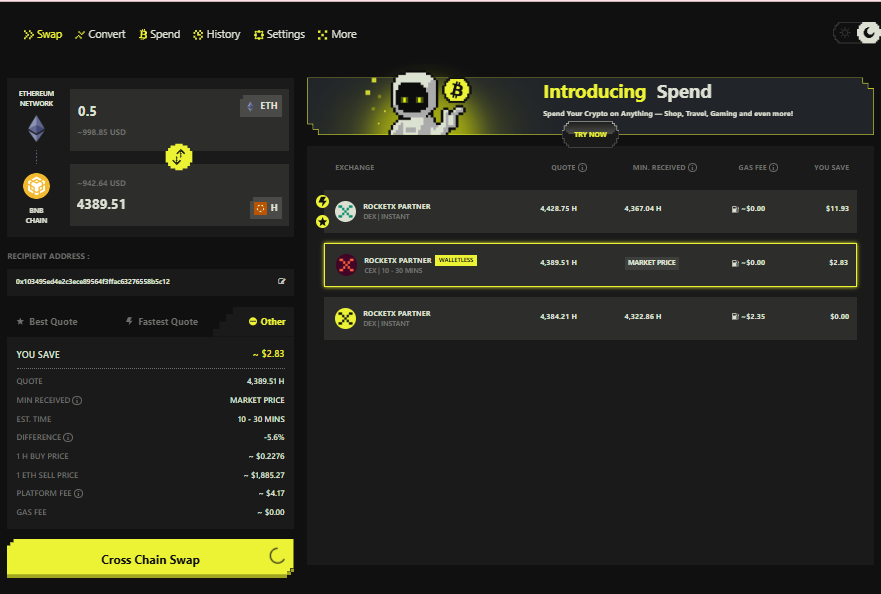
Step 5: Review and Confirm
Check the transaction details, including:
- Amount of H tokens you’ll receive
- Platform fee
- Gas fee (shown upfront)
- Estimated completion time
Step 6: Execute Swap.
Click the yellow “Swap” or “Cross Chain Swap” button, approve the transaction in your wallet, and wait for H tokens to arrive.
Price Predictions and Market Analysis
Short-Term Outlook (Q1-Q2 2026)
Based on technical indicators and current market momentum, analysts forecast the H token could target the $0.35-$0.38 range by late Q1 2026, representing a 15-18% increase from current levels. This growth would be driven by:
- Increasing adoption of Human ID verification across dApps
- Scheduled ecosystem updates and feature releases
- Continued exchange listings expanding accessibility
- Growing awareness of privacy-focused identity solutions
Medium-Term Projections (2026-2027)
Key developments expected to drive value in 2026-2027:
Decentralized Governance Launch (2026): Transitioning full protocol control to H token holders creates utility beyond speculation. Token holders will vote on treasury allocation, protocol upgrades, and strategic decisions, giving H token tangible governance value.
Expanded Web3 Integrations (2026): As more dApps, games, and DeFi protocols integrate Human ID verification, demand for H tokens increases. Each new integration expands the network effect and use cases.
zkProof Upgrades (Targeted 2027): Enhanced privacy features for selective disclosure will position Humanity Protocol as the gold standard for compliant, privacy-preserving identity verification, particularly important as data protection regulations evolve globally.
Long-Term Vision (2028-2030)
Analysts project the H token could reach $0.75-$1.07 by 2030, with some optimistic forecasts extending to $1.85 by 2035. These projections assume:
- Widespread adoption of decentralized identity as Web3 infrastructure
- Successful execution of the protocol roadmap
- Favorable regulatory environment for privacy-focused technologies
- Continued growth of the broader cryptocurrency market
- Integration with traditional finance through partnerships like Mastercard
Important Disclaimer: The cryptocurrency market is highly volatile. These price predictions are based on historical data, technical analysis, and fundamental assumptions that may not materialize. Past performance does not guarantee future results. Always conduct your own research and never invest more than you can afford to lose.
Risks and Considerations
Technology Risks
Smart Contract Vulnerabilities: While Humanity Protocol’s code has undergone audits, all blockchain systems face potential smart contract exploits. Users should only invest what they can afford to lose.
Adoption Uncertainty: The protocol’s success depends on widespread adoption by dApps, users, and enterprises. Slow adoption could limit utility and token value.
Competing Solutions: Other projects like Worldcoin are developing alternative approaches to digital identity. Multiple successful competitors could fragment the market.
Market Risks
Cryptocurrency Volatility: The H token price can fluctuate dramatically based on broader crypto market conditions, regardless of protocol fundamentals.
Regulatory Uncertainty: Biometric data collection faces scrutiny in many jurisdictions. Changing regulations could impact Humanity Protocol’s operations in specific regions.
Token Unlock Pressure: Scheduled vesting and token unlocks will increase circulating supply over time, potentially creating selling pressure if demand doesn’t keep pace.
Privacy Considerations
Biometric Data Permanence: Once you verify with palm recognition, that biometric association is permanent on-chain. Users cannot change their biometric identifiers like they can change passwords.
Future Attack Vectors: While current zero-knowledge implementations protect privacy, future quantum computing or cryptographic breakthroughs could theoretically compromise these protections.
Correlation Risks: If users link their Human ID to multiple platforms, sophisticated actors might correlate activities across services, potentially reducing pseudonymity.
Frequently Asked Questions (FAQ)
What makes Humanity Protocol different from traditional identity systems?
Humanity Protocol is decentralized, meaning no single authority controls user identity data. Users maintain sovereignty over their credentials and can selectively prove identity attributes using zero-knowledge proofs without revealing underlying personal information. Traditional systems require surrendering personal data to centralized databases, creating privacy risks and single points of failure.
Is my biometric data stored on the blockchain?
No. Humanity Protocol never stores raw biometric data. When you scan your palm, the system immediately converts it into a cryptographic hash using zero-knowledge proofs. This hash cannot be reversed to recreate your original palm print. Only the mathematical proof of your uniqueness exists on-chain, not your actual biometric information.
How does Humanity Protocol prevent someone from creating multiple Human IDs?
The biometric verification process ensures each palm print is unique. The system checks new registrations against all existing human IDs on the blockchain. If you attempt to register a second time with the same palm, the cryptographic proof will match an existing entry and prevent duplicate registration, maintaining the one-person-one-ID principle.
Can I delete my Human ID if I change my mind?
Human IDs are permanent on the blockchain once created. However, you control when and where you use your Human ID for verification. You can choose not to share your credentials with specific platforms or services, maintaining practical privacy even if the ID itself is permanent.
What happens if I lose access to my wallet containing my Human ID?
Your Human ID exists on the blockchain and is linked to your biometric data, not solely to your wallet. Humanity Protocol provides recovery mechanisms where you can re-verify your identity with your palm scan and regain access. The specific recovery process continues to evolve as the protocol matures.
How does the H token gain value?
The H token value is driven by utility within the Humanity Protocol ecosystem, governance rights, scanner operator rewards, and speculation on future adoption. As more dApps integrate Human ID verification and demand for identity services grows, the fundamental value proposition of H tokens strengthens. Additionally, fixed supply dynamics create scarcity as adoption increases.
Is palm recognition safe? Can it be spoofed?
Palm recognition technology is highly secure and difficult to spoof. Modern palm vein scanners detect blood flow patterns beneath the skin, making fake palm creation extremely difficult. Humanity Protocol’s multi-factor approach, combining palm prints and palm veins, provides robust security against spoofing attempts.
Which countries or regions can use Humanity Protocol?
Humanity Protocol aims for global accessibility. Mobile palm verification (Phase 2) is rolling out worldwide, though specific availability varies by region. Physical Humanity Scanners (Phase 3) are initially concentrated at crypto events and major cities, with expansion planned throughout 2026. Check the official Humanity Protocol website for current regional availability.
How does the Mastercard integration work?
The Mastercard Open Finance integration allows Human ID holders to verify financial attributes like bank account ownership without sharing account details. Using privacy-preserving credentials, you can prove you meet financial requirements for loans, credit, or RWA investments without manual paperwork or exposing sensitive financial data.
Conclusion
Humanity Protocol represents a fundamental shift in how we approach digital identity, privacy, and human verification in an increasingly automated world. As artificial intelligence, bots, and Sybil attacks proliferate across the internet, the ability to prove uniquely human participation becomes critical infrastructure for Web3 and beyond.
The protocol’s innovative combination of palm recognition biometrics, zero-knowledge proofs, and blockchain immutability creates a powerful solution to long-standing problems in digital identity. Unlike centralized alternatives that require trusting corporations or governments with sensitive data, Humanity Protocol empowers individuals with true data sovereignty.
For traders and investors on RocketX Exchange, the H token presents an opportunity to participate in building this critical infrastructure layer while potentially benefiting from its growth. The protocol’s strong fundamentals—including a $1.1 billion valuation, strategic partnerships with Mastercard, and backing from top-tier crypto investors—suggest serious long-term potential.
As we move deeper into 2026, watch for key milestones like the Phase 3 scanner rollout, decentralized governance launch, and expanding dApp integrations. These developments will determine whether Humanity Protocol fulfills its vision of becoming the standard for human verification in Web3.
The future of identity is privacy-preserving, user-controlled, and decentralized. Humanity Protocol is building that future today.