Introduction
The internet runs on data, and every photo, video, document, and transaction needs a place to live. Today, most of this data is stored by centralized giants like Amazon, Google, and Microsoft. While convenient, this system comes with serious trade-offs like censorship, high costs, single-point failures, and increasing privacy risks.
This is where Filecoin steps in as a decentralized alternative to traditional cloud storage. Instead of trusting a single company to hold your data, Filecoin uses a distributed network of independent storage providers around the world. Anyone can rent out unused storage space and get rewarded, and anyone can pay to store data in a secure, censorship-resistant environment.
But Filecoin is not just a storage marketplace; it is a growing blockchain ecosystem with a native cryptocurrency (FIL), upcoming roadmap upgrades, integrations with major Web3 platforms, and active use cases across NFTs, AI datasets, archives, and Web3 infrastructure.
Before we explore how to move assets into this network using tools like RocketX, let’s understand why Filecoin has become a key pillar of decentralized infrastructure.
What Is the Filecoin Network and How Does It Work?
Filecoin is a decentralized storage network designed to provide a secure, censorship-resistant alternative to centralized cloud services. Instead of depending on a single company to store your data, it uses a distributed marketplace of independent storage providers around the world.
Who created Filecoin?
It was developed by Protocol Labs, a research and development company founded by Juan Benet, the same team behind the InterPlanetary File System (IPFS). The project was first introduced in 2014 and later raised over $200 million in 2017 during one of the largest ICOs of that time. The Filecoin mainnet officially launched in October 2020.
How the Network Works
There are two main actors in the ecosystem:
1) Storage Providers (Storage Miners)
They offer unused disk space to store user data in exchange for FIL tokens.
2) Retrieval Providers (Retrieval Miners)
They deliver stored data when users request it and earn FIL for quick retrieval.
To make sure data is stored honestly and securely, Filecoin relies on advanced cryptographic proofs:
- Proof-of-Replication (PoRep): Confirms that a unique copy of the data is stored.
- Proof-of-Spacetime (PoSt): Proves that the storage provider continues to store that data over time.
Unlike Google Drive or AWS, where trust depends on the company, Filecoin creates trust through math, incentives, and blockchain transparency. Every deal and verification is recorded on-chain, making the system tamper-resistant and verifiable.
With its strong technical foundation, open participation model, and alignment with real-world utility, Filecoin has become one of the leading infrastructures in the Web3 storage ecosystem.
Why Decentralized Storage Matters in the Digital Age
Almost everything we do online, such as photos, videos, websites, apps, bank records, and documents, needs to be stored somewhere. Today, most of this storage is controlled by a few big companies like Google, Amazon, and Microsoft. This system works, but it also brings serious risks and limitations.
When all your data is kept inside the servers of one company, it becomes easier to attack, hack, censor, or even shut down. If the company changes its policies, deletes data, or comes under government pressure, users have no power over their own information. Centralized storage also creates privacy concerns because your data can be watched, shared, or leaked. Along with this, the cost of storage is often high because only a few providers dominate the industry and set the pricing.
Filecoin offers a completely different model. Instead of storing files in one central location, it spreads storage across thousands of independent computers around the world. This removes single-point failures and makes it much harder for anyone to manipulate or block access to data. Storage providers compete in an open marketplace, which naturally drives prices lower. The network runs on transparent rules and cryptography rather than the authority of a single organization.
As the world moves towards Web3, artificial intelligence, and blockchain-driven systems, people want more control, privacy, and long-term security. Filecoin is one of the strongest networks leading this change, and its demand continues to grow as more developers, users, and projects shift toward decentralized storage for safer digital data ownership.
Understanding the FIL Token and Its Tokenomics
FIL is the native cryptocurrency that is used inside the network to make the system work fairly and efficiently. Whenever someone wants to store data on Filecoin, they pay storage providers in FIL. Miners who store or retrieve data are rewarded in FIL for performing honest work. Storage providers also have to lock some FIL as collateral to prove they are trustworthy and will not lose or tamper with user data. This creates a financial incentive to behave correctly.
FIL has a controlled supply. The maximum supply is capped at 1.96 billion tokens. A portion of these tokens is released gradually as rewards to miners over time. As of today, more than 700 million FIL are already in circulation. This slow and predictable release helps avoid sudden inflation.
FIL also plays a role in the future governance of the network. Over time, decisions and upgrades to the Filecoin protocol may be governed by those who hold FIL in the ecosystem, making it not just a utility token but also a token that represents influence in the network.
In short, FIL keeps the entire system running. It motivates miners to provide storage, ensures security, allows users to buy space, and helps maintain the economy of the Filecoin network. As the demand for decentralized storage grows, the utility and value of FIL are likely to reflect that growth.
Now that we have a clear understanding of what FIL is and its role within the ecosystem, it’s time to get hands-on with how you can transfer your assets to the Filecoin network. This is where RocketX comes in handy.
How to Bridge to Filecoin Using RocketX Exchange (Step-by-Step Guide)
Once you’ve understood what Filecoin is and why decentralized storage is becoming essential for the future of Web3, the next practical step is actually moving your assets onto this network. Instead of depending on complicated manual bridges or multiple swap platforms, RocketX Exchange allows you to swap from any supported blockchain directly to Filecoin in a single unified transaction.
RocketX currently supports 195+ blockchains, which means whether your funds are on Ethereum, BNB Chain, Solana, Polygon, Arbitrum, Avalanche, Base, or any major L1/L2, you can convert your crypto to FIL smoothly without switching platforms.
Even if we take Ethereum as a simple example, the same steps apply whether you want to bridge ETH to FIL, SOL to FIL, or AVAX to FIL. The flow on RocketX remains the same — this is the power of cross-chain aggregation.
Follow this step-by-step process to bridge to Filecoin:
Step 1 — Open RocketX Exchange and Connect Your Wallet
Go to app.rocketx.exchange using your browser. Connect a wallet that holds your crypto — such as MetaMask, Rabby, Trust Wallet, OKX Wallet, Phantom (for Solana), or Coinbase Wallet. RocketX supports multi-chain wallets, so choose the one where your funds currently are.
Step 2 — Select the Source Network and Token
Choose the blockchain where your assets currently exist.
Example: If your funds are on Ethereum, choose Ethereum and select ETH or any other token you want to convert.
Step 3 — Select Filecoin as the Destination Network and Choose FIL
Now select Filecoin as the destination blockchain and choose FIL as the token you want to receive.
Step 4 — Enter the Amount and Add the Recipient Address
Enter how much crypto you want to bridge. Then paste your Filecoin-compatible wallet address where the FIL tokens will be delivered. (If you don’t already have a FIL wallet, read the next section below where we explain the top secure wallets you can use for storing Filecoin tokens safely.)
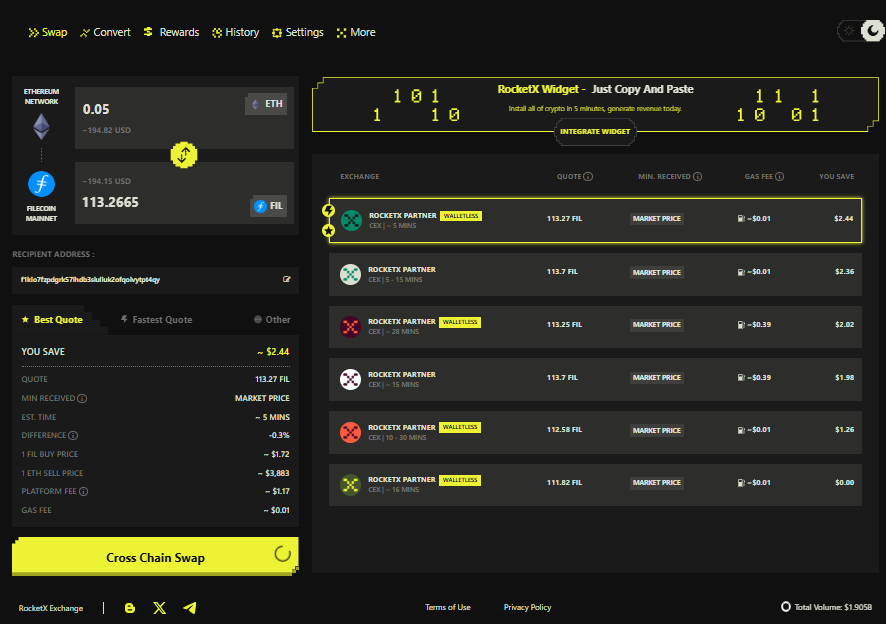
Step 5 — Confirm the Cross-Chain Swap and Approve Transaction
Click “Cross-Chain Swap” and approve the request through your connected wallet. RocketX will automatically route the best path from your selected network into Filecoin.
Step 6 — Check Your Wallet After Completion
Once the swap is complete, open your Filecoin wallet to verify that the FIL tokens have arrived. Your assets are now ready to be used across Filecoin’s ecosystem.
With RocketX, you don’t need separate bridges, wrapped versions, or multiple wallets — the platform simplifies the entire bridging process into one clean flow.
Top Wallets for Safely Storing Your FIL Tokens
As FIL is gaining rapid adoption across Web3, several trusted wallets now support storing, sending, and interacting with Filecoin tokens. The wallet you choose mainly depends on what you value most, whether it is maximum security, browser-based convenience, or quick mobile access on the go.
For users who want the highest level of protection, Ledger Hardware Wallet remains the strongest option. Since Ledger stores private keys offline, it becomes extremely difficult for hackers or malware to compromise funds. Ledger is ideal for long-term holders and large FIL positions.
If you prefer managing Filecoin directly through your browser, Glif Wallet is one of the most dedicated Filecoin-native options. It is easy to use, supports direct Filecoin interactions, and can be connected with Ledger for dual-layer security.
For users who prefer mobile-first access, Trust Wallet, MathWallet, and FoxWallet are excellent choices. These wallets support hundreds of assets across multiple networks — making it simple to store, transfer, and interact with FIL along with other tokens from a single app.
As Filecoin storage demand grows, wallet ecosystem support will continue to increase, offering users even more flexibility, accessibility, and security choices for their FIL tokens.
Filecoin’s Future Potential: Leading the Decentralized Storage Movement
The future potential of Filecoin is very strong as the world continues moving toward decentralized, permissionless, and censorship-free digital infrastructure. With the growth of AI, massive global data consumption, long-term data archiving, research preservation, NFT storage, enterprise Web3 adoption, and on-chain gaming assets, the need for secure decentralized data storage will continue rising year after year. Filecoin is positioned right in the center of this new data-driven economy.
In the coming years, Filecoin aims to expand through several roadmap improvements, such as smarter retrieval networks, easier onboarding for large datasets, more competitive storage pricing, stronger developer tools, and deeper integration with major blockchain networks, including Ethereum, Solana, modular chains, and emerging L2 ecosystems. Filecoin is also moving closer to decentralized compute, making it extremely relevant for the future AI economy.
Since Filecoin already solves a real-world problem that every digital user and enterprise faces, its long-term value narrative is backed by real utility rather than pure speculation. With Protocol Labs driving continuous innovation, expanding global participation, and the rise in demand for trustworthy decentralized storage, FIL has the potential to become one of the most important digital assets in Web3. As data becomes the most valuable commodity of the modern world, Filecoin could evolve into a fundamental storage layer powering the future internet.
Conclusion
Filecoin is shaping a new era where data storage becomes more open, secure, and user-controlled. As Web3 continues to expand, the importance of storing information in a decentralized environment will only grow stronger. Filecoin brings forward a practical solution that is already being used today, not just imagined for the future. With easy cross-chain access through platforms like RocketX, users can move their assets into the Filecoin network anytime and start exploring the ecosystem without technical barriers. As innovation continues and adoption increases, Filecoin stands ready to support the next generation of applications, builders, and digital infrastructure with confidence, efficiency, and long term value.