Key Takeaway
- Tokenized stocks allow investors to gain blockchain-based exposure to publicly traded companies like Apple, Nvidia, Tesla, Microsoft, Amazon, and Coinbase through regulated issuers and supported trading platforms.
- The leading tokenized stock ecosystem includes platforms such as xStocks, Kraken, Robinhood, Dinari, Binance, and Backed Finance, each offering different regulatory frameworks, supported assets, and regional availability.
- RocketX is a non-custodial tokenized stock access platform that integrates with the xStocks ecosystem, allowing users to swap crypto directly into supported tokenized stocks across 200+ blockchain networks without manually bridging assets or using multiple platforms.
- Rather than issuing tokenized stocks, RocketX combines cross-chain aggregation, intelligent routing, and wallet-based execution to help users access supported tokenized stock ecosystems, including Jupiter, Backpack, and compatible EVM DEXs powered by xStocks.
- Before buying tokenized stocks, investors should compare asset backing, issuer structure, regulatory compliance, liquidity, supported blockchains, and regional availability, as these factors vary significantly across platforms.
Introduction
Tokenized stocks are rapidly changing how investors access traditional equities.
Instead of relying solely on traditional brokerage accounts, investors can now gain blockchain-based exposure to companies like Apple, Tesla, Nvidia, Microsoft, Amazon, and Coinbase through supported tokenized stock platforms and blockchain ecosystems. As tokenized finance continues to grow, investors are no longer asking, “What are tokenized stocks?” They’re asking a far more practical question:
Where can I buy tokenized stocks, and which platform is the best choice?
The answer isn’t as simple as opening an account with a single exchange.
Unlike traditional stocks, tokenized equities are available across multiple issuers, blockchain networks, trading platforms, and liquidity venues. Some are issued through regulated frameworks backed by real shares, while others provide synthetic or wrapped exposure with different legal rights and ownership structures. Regional availability, custody models, and supported assets can also vary significantly from one platform to another.
This complexity is emerging alongside rapid market growth. According to the 2026 Mid-Year RWA Report on Tokenized Stocks and related research from CCData and insights4vc, the onchain distributed value of tokenized equities increased from approximately $951 million in March 2026 to around $1.89 billion by late July 2026. The same research also highlights that many tokenized stock products provide economic exposure rather than full shareholder of record rights, while liquidity remains fragmented across multiple ecosystems.
As a result, choosing where to buy tokenized stocks is no longer just about finding a platform that lists your favorite company. Investors should also evaluate:
- Asset backing and issuer structure
- Legal rights and investor protections
- Supported blockchain networks
- Available liquidity
- Regional availability and compliance
- Cross-chain accessibility
This guide compares the leading platforms for buying tokenized stocks in 2026, including xStocks, Robinhood, Kraken, Dinari, and other major ecosystems. It also explains what to consider before investing, how different platforms compare, and why cross-chain infrastructure is becoming increasingly important as tokenized stocks expand across multiple blockchain networks.
If you’re looking for a complete overview of how tokenized stocks work, their benefits, risks, and legal structures, read our Tokenized Stocks Explained guide before continuing.
Where Can You Buy Tokenized Stocks?
Unlike traditional stocks, tokenized stocks aren’t available through a single exchange or brokerage. They can be accessed through a growing ecosystem of regulated issuers, crypto exchanges, decentralized trading platforms, and blockchain applications.
The right platform depends on what you’re looking for. Some prioritize regulatory compliance and direct asset backing, while others focus on on-chain accessibility, self-custody, or seamless integration with crypto ecosystems.
Today, most investors buy tokenized stocks through one of the following categories.
1. Regulated Tokenized Stock Issuers
These organizations create and issue tokenized stock products under a defined legal and custody framework. Depending on the issuer, the tokens may be backed 1:1 by real shares held by a regulated custodian or structured to provide economic exposure to the underlying stock.
Leading issuers include:
- Dinari: Known for its compliant “dShares” model. It operates as an SEC-registered transfer agent, backing tokens 1:1 with real physical equities to pass through true corporate cash dividends.
- Backed Finance: The core Swiss-regulated tokenization provider behind the massive, cross-chain xStocks ecosystem. It issues 1:1 asset-backed ERC-20 and SPL tokens across public ledgers.
- Ondo Finance: Specializes in institutional-grade tokenization through its Ondo Global Markets layer. It wraps publicly traded equities and short-term liquidity funds into decentralized assets used primarily for B2B exchange liquidity.
- Other regulated tokenization providers like Tokeny, Midas, Securitize, etc. building blockchain-based financial products.
If understanding ownership rights and asset backing is your priority, the issuer is just as important as the platform where you trade.
2. Exchanges and Trading Platforms
Once tokenized stocks are issued, they become available through supported exchanges and trading applications.
Some platforms provide a familiar brokerage-style experience, while others allow users to trade directly from self-custodial wallets.
Popular access points include:
- Kraken
- Robinhood
- Binance Wallet
- Jupiter and other applications supporting the xStocks ecosystem
Each platform differs in supported assets, custody model, geographic availability, and user experience, so investors should compare these factors before choosing where to trade.
3. Cross-Chain Access Infrastructure
As tokenized stocks expand across multiple blockchain ecosystems, buying them is no longer just about choosing the right platform. You also need to get your assets onto the right blockchain. For example, you might hold USDC on Base or ETH on Arbitrum, while the tokenized stock you want is available on another network. This is where RocketX comes in.
RocketX is not a tokenized stock issuer or brokerage. Instead, it is a non custodial cross chain aggregator that helps users swap directly into supported tokenized stocks through the xStocks ecosystem. By integrating with xStocks supported platforms, including Jupiter, Backpack, and compatible EVM DEXs, RocketX enables seamless access to more than 600 tokenized stocks and ETFs without requiring users to manually bridge assets across multiple chains.
Why Tokenized Stocks Are Growing So Quickly
Tokenized stocks have evolved from a niche blockchain experiment into one of the fastest-growing segments of the real-world asset (RWA) market. While the industry is still developing, recent data shows that adoption is accelerating as both crypto-native companies and traditional financial institutions expand their tokenization efforts.
Rapid Market Growth
The onchain distributed value of tokenized equities increased from approximately $951 million in March 2026 to around $1.89 billion by late July 2026. This rapid growth reflects increasing demand for blockchain-based access to publicly traded equities and exchange-traded funds.
More investors are exploring tokenized stocks because they offer benefits such as fractional investing, faster settlement, global accessibility, and compatibility with blockchain ecosystems.
Traditional Finance Is Entering the Market
The growth of tokenized stocks is no longer being driven solely by crypto companies.
In July 2026, the Depository Trust & Clearing Corporation (DTCC) announced successful live production trades using tokenized assets ahead of a broader tokenization platform rollout. This signals that tokenization is gradually becoming part of mainstream financial market infrastructure rather than remaining a crypto-only innovation.
As more financial institutions invest in tokenization, the ecosystem is expected to become more mature, regulated, and accessible.
Tokenized Stocks Are Not All the Same
Despite the market’s rapid expansion, investors should understand that tokenized stocks can differ significantly in how they are structured.
According to the same mid-year research, more than 90% of circulating tokenized stock products currently provide economic exposure rather than full shareholder of record status.
Depending on the issuer, token holders may not receive:
- Direct legal ownership of the underlying shares
- Shareholder voting rights
- Traditional shareholder protections
This is why it’s important to understand who issued the tokenized stock, not just where it is traded.
Liquidity Is Still Fragmented
Another challenge facing the market is liquidity.
Tokenized stocks are currently spread across multiple issuers, exchanges, blockchain networks, and trading platforms. As a result, liquidity is fragmented, and price discovery is still developing across different ecosystems.
For investors, this means that choosing where to buy tokenized stocks involves more than finding the lowest trading fee. The quality of the platform, available liquidity, supported blockchain, and ease of moving assets between ecosystems can all affect the overall investing experience.
Tokenized Stock Platforms Comparison (August 2026)
|
Platform / Framework |
Regulatory / Structural Positioning |
Supported Networks |
Geographic Availability |
|
xStocks (Backed Finance) |
Swiss-regulated tokenized stock issuance framework operated by Backed Finance |
Solana, Ethereum, TON, Mantle, Ink, Arbitrum, BSC |
Not available in the U.S., UK, Canada, or Australia |
|
Binance |
ADGM approved the prospectus structure for supported tokenized stock products. |
Binance ecosystem |
Restricted in the U.S. and other prohibited jurisdictions |
|
Kraken |
International exchange integrating the xStocks ecosystem |
Solana, Ethereum, BSC, Tron, Ton, Avalanche, Ink |
Not available in the U.S., UK, Canada, or Australia for supported products |
|
Dinari |
SEC-registered broker-dealer and tokenized stock issuer |
Arbitrum, Ethereum, Polygon, Base, Plume, Avalanche |
Available in the U.S. and more than 80 countries |
|
Robinhood |
U.S. brokerage with EU crypto regulatory approvals for supported products |
Robinhood Layer 2 ecosystem |
Availability varies by region |
|
RocketX |
Non-custodial platform integrating the xStocks ecosystem with cross-chain aggregation |
200+ blockchain networks |
Available wherever supported, tokenized stock ecosystems are accessible. |
How RocketX Fits Into the Tokenized Stock Ecosystem
As tokenized stocks expand across multiple blockchain ecosystems, investing is no longer just about choosing the right platform. Investors also need an efficient way to access the blockchain where their desired tokenized stocks are available.
For example, you might hold USDC on Base, ETH on Arbitrum, or SOL on Solana, while the tokenized stock you want is available through an xStocks-powered ecosystem. Moving assets manually between blockchains can involve multiple bridges, decentralized exchanges, and wallets, making the process slower and more complex.
This is where RocketX comes in.
RocketX is not a tokenized stock issuer or brokerage. Instead, it is a non-custodial tokenized stock access platform that integrates with the xStocks ecosystem while leveraging its cross-chain aggregation technology to simplify the entire journey.
Through RocketX, users can move assets across 200+ blockchain networks and access supported tokenized stock ecosystems without manually coordinating multiple cross-chain transactions.
RocketX supports ecosystems that integrate xStocks, including supported Jupiter markets, Backpack, and compatible EVM decentralized exchanges offering xStocks-powered tokenized stocks.
As one of the largest tokenized stock ecosystems, xStocks now supports 600+ tokenized stocks and ETFs, giving users access to a broad range of publicly traded companies and exchange-traded funds through participating platforms.
Rather than acting as the issuer, RocketX serves as the access layer between investors and the growing xStocks ecosystem. It combines cross-chain asset routing with non-custodial execution, making it easier for users to reach supported tokenized stock markets from the blockchain they already use.
How to Buy Tokenized Stocks Using RocketX
RocketX makes it easy to buy supported tokenized stocks by combining cross-chain aggregation, intelligent routing, and xStocks ecosystem integration into a single non-custodial platform.
Instead of manually bridging assets, switching between decentralized exchanges, and searching for the best liquidity, RocketX lets you swap directly from your existing crypto assets into supported tokenized stocks while automatically finding the most efficient execution route.
Here’s how the process works.
Step 1: Connect Your Wallet
Start by connecting your preferred self-custodial wallet to RocketX.
You can begin with assets on more than 200 supported blockchain networks, including Bitcoin, Ethereum, Solana, Base, Arbitrum, BNB Chain, Polygon, Avalanche, and many others.
No account creation or custody transfer is required.
Step 2: Choose the Asset You Want to Spend
Select the cryptocurrency you already own.
For example, you can swap directly from:
- BTC
- ETH
- SOL
- BNB
- USDC
- USDT
and many other supported assets.
There’s no need to manually bridge funds before starting the transaction.
Step 3: Select the Tokenized Stock
Choose the supported tokenized stock you want to receive.
RocketX supports ecosystems that integrate xStocks, including supported Jupiter markets, Backpack, and compatible EVM decentralized exchanges offering xStocks-powered assets. Through these integrations, users can access hundreds of supported tokenized stocks and ETFs available within the xStocks ecosystem.
For example, you can receive supported assets such as
- AAPLX (Apple)
- NVDAX (NVIDIA)
- MSTRX (MicroStrategy)
along with many other supported xStocks.
Step 4: Compare Available Routes
Once you enter the trade, RocketX automatically searches multiple liquidity sources to identify the best execution.
Depending on the trading pair, you’ll see several routing options, including:
- Best for the highest estimated output
- Fastest for quicker settlement
- Private for eligible trades that use privacy-focused routing
Instead of relying on a single exchange or liquidity pool, RocketX compares available routes so you can choose the option that best fits your priorities.
Step 5: Review the Quote
Before confirming the transaction, RocketX displays important execution details, including:
- estimated amount of tokenized stock you’ll receive
- minimum received amount
- estimated settlement time
- network fees
- platform fees
- price impact
- expected savings compared to other routes
This gives you greater transparency before executing the swap.
Step 6: Complete the Swap
After confirming the transaction in your wallet, RocketX executes the selected route.
Once the swap is complete, the supported tokenized stock is delivered directly to your wallet, allowing you to retain control of your assets throughout the process.
Real-World Examples Using RocketX Exchange
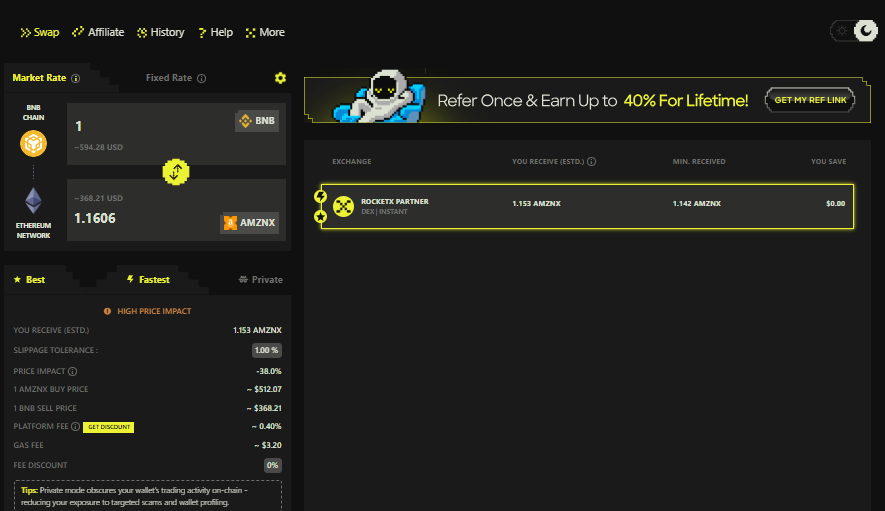
1. Buy AMZN Tokenized Stock on the Ethereum Blockchain with BNB Token
Suppose you hold BNB on Binance Chain and want to acquire AMZNX.
With RocketX, you simply select BNB as the asset you’re sending and AMZNX as the asset you want to receive. RocketX then compares available execution routes and displays multiple options, including Best, Fastest, and Private routes, before executing the swap.
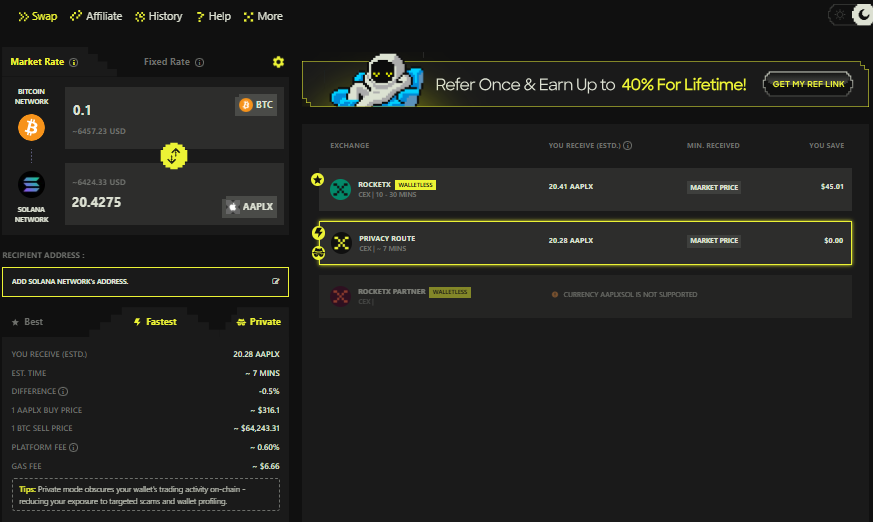
2. Buy Apple Tokenized Stock on the Solana Chain with Bitcoin
If you hold BTC but want exposure to AAPLX, you don’t need to manually bridge Bitcoin to another blockchain first.
RocketX automatically handles the cross-chain routing required to deliver the supported tokenized stock through its integrated ecosystem.
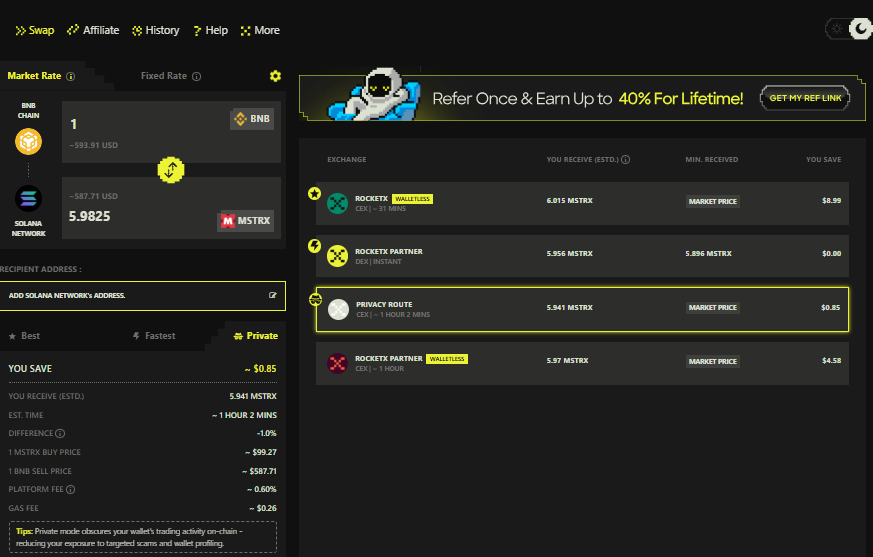
3. Buy MicroStrategy Tokenized Stock on Solana Chain with BNB
Users holding BNB can swap directly for MSTRX through RocketX.
Rather than moving assets across several platforms, RocketX identifies the available route and completes the transaction through its integrated liquidity network.
Why Use RocketX?
Buying tokenized stocks often involves more than finding the right issuer. You also need access to the right blockchain, liquidity source, and trading venue.
RocketX simplifies this process by combining:
- Support for 200+ blockchain networks
- Non-custodial wallet-based trading
- Intelligent cross-chain routing
- Multiple execution options, including Best, Fastest, and Private
- Access to supported xStocks-powered tokenized stock ecosystems
- Transparent quotes before execution
As tokenized stocks continue expanding across blockchain ecosystems, this approach gives investors a more efficient way to access supported onchain equity markets without manually coordinating bridges, swaps, and multiple trading platforms.
Tokenized Stocks’ Future Outlook
The tokenized stock market is still in its early stages, but recent industry developments suggest it is moving toward broader institutional adoption rather than remaining a crypto niche.
Traditional and Onchain Markets Will Coexist
Recent industry surveys indicate that most financial institutions expect tokenized and traditional equities to operate side by side. Instead of replacing existing markets, tokenization is likely to enhance how assets are issued, traded, and settled.
Hybrid Financial Infrastructure Is Emerging
Many institutions are choosing to modernize their existing infrastructure by integrating blockchain technology, rather than rebuilding financial markets from scratch. This hybrid approach could accelerate the adoption of tokenized securities.
Growth Beyond Individual Stocks
While single company stocks are attracting attention, tokenized ETFs, index funds, and other real-world assets are expected to expand even faster as the market matures.
Cross-Chain Access Will Become Essential
As tokenized stocks become available across multiple issuers, blockchains, and trading venues, investors will increasingly need efficient ways to move assets between ecosystems. Platforms like RocketX, which combine cross-chain aggregation with access to supported tokenized stock ecosystems, are well positioned to simplify this experience.
The long-term opportunity is not just tokenizing stocks. It is creating a more connected financial system where investors can access tokenized assets across multiple blockchain networks through a seamless, non-custodial experience.
Frequently Asked Questions
Where can I buy tokenized stocks in 2026?
You can buy tokenized stocks through platforms like Kraken, Robinhood, Dinari, Binance (where available), and the xStocks ecosystem. If you already hold crypto on another blockchain, RocketX lets you access supported tokenized stock ecosystems through cross-chain swaps.
What is the best platform to buy tokenized stocks?
The best platform depends on your needs. Dinari focuses on regulated access, while Kraken and Robinhood offer retail trading, and RocketX is ideal for users who want to swap crypto directly into supported tokenized stocks across multiple blockchains.
Can I buy tokenized stocks on RocketX?
Yes. RocketX allows users to swap supported cryptocurrencies into tokenized stocks available through the xStocks ecosystem. It is not the issuer but a non-custodial platform that provides cross-chain access and routing.
What are xStocks?
xStocks is a tokenized stock ecosystem developed by Backed Finance that offers 1:1 backed tokenized U.S. stocks and ETFs. These assets are available across multiple supported exchanges, wallets, and blockchain applications.
Can I buy Apple or Tesla tokenized stocks?
Yes, if they are supported in your region. Many platforms offer tokenized versions of companies like Apple, Tesla, Nvidia, and MicroStrategy, although availability depends on local regulations.
Are tokenized stocks backed by real shares?
Some are backed 1:1 by real shares held by regulated custodians, while others provide synthetic or wrapped exposure. Always check the issuer’s documentation before investing.
Do tokenized stocks provide shareholder rights?
Not always. Depending on the issuer, token holders may receive economic exposure without voting rights or direct legal ownership of the underlying shares.
Why use RocketX to buy tokenized stocks?
RocketX simplifies the process by combining cross chain aggregation with access to supported xStocks ecosystems. It lets users buy supported tokenized stocks directly from existing crypto assets without manually bridging between blockchains.
Final Verdict
Tokenized stocks are transforming how investors access global equity markets by bringing traditional assets onto blockchain networks. However, choosing where to buy them involves more than simply selecting an exchange. Investors should compare the issuer, regulatory framework, blockchain ecosystem, available liquidity, and regional availability before making a decision.
Platforms such as xStocks, Kraken, Dinari, Robinhood, Binance, and Backed Finance are driving the growth of tokenized equities, each serving a different role within the ecosystem.
RocketX complements these platforms by acting as the non-custodial access layer rather than the issuer. Through its integration with the xStocks ecosystem and support for more than 200 blockchain networks, RocketX enables users to swap directly from their existing crypto assets into supported tokenized stocks without manually coordinating bridges, exchanges, or multiple wallets.
As tokenized stocks continue expanding across new blockchains and trading ecosystems, seamless cross-chain access and efficient liquidity routing will become just as important as the tokenized assets themselves.