Key Takeaways
- Hybrid routing accesses both centralized and decentralized liquidity, increasing the likelihood of finding better execution opportunities.
- Cross-chain transactions involve multiple moving parts, making broader route discovery valuable for optimizing cost, speed, and reliability.
- The best trading route is not always the cheapest quoted route; fees, slippage, and settlement time can significantly affect the final outcome.
- RocketX leverages hybrid CEX + DEX aggregation to help users find the best route across chains, liquidity sources, and execution venues.
- While single-stack aggregators remain ideal for fully on-chain execution, hybrid routing offers greater flexibility in today’s fragmented multichain ecosystem.
Introduction
Crypto routing has become a category of its own. DefiLlama currently tracks roughly $62.4 billion in 30-day DEX aggregator volume and about $2 billion in 30-day bridge-aggregator volume, which shows how much activity now depends on routing layers rather than single venues. In that environment, the real question is no longer just “Which exchange should I use?” It is “Which routing model gives me the best execution for this trade?”
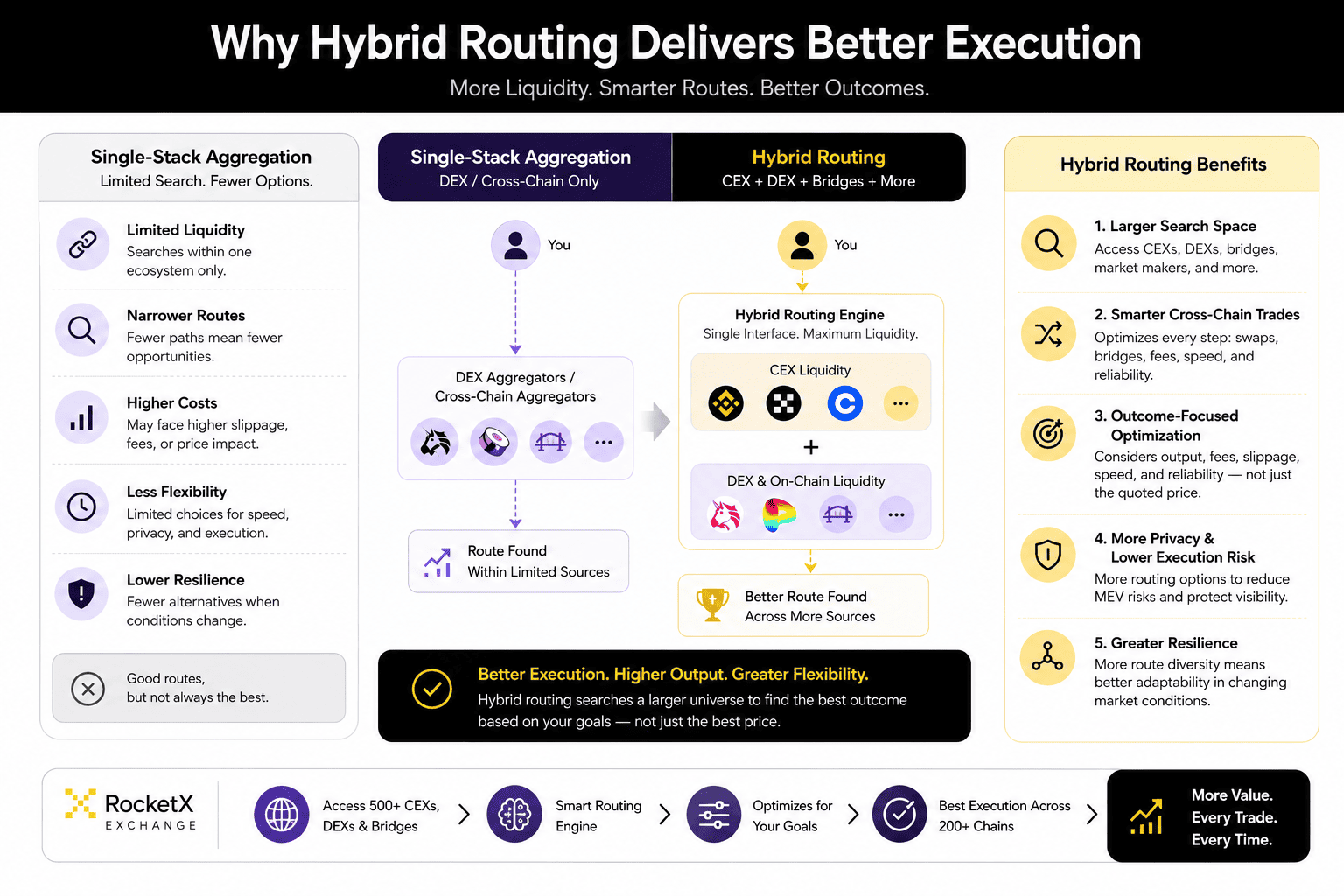
Short answer: hybrid CEX + DEX routing can beat single-stack aggregation because it searches a broader liquidity universe, offers more route flexibility across chains, and gives users more ways to optimize for price, speed, slippage, and privacy. That does not mean single-stack aggregators are weak. In fact, some are excellent. It means that in a fragmented multichain market, wider route access often creates better odds of a better outcome.
Here’s a more polished and authoritative version of the section:
What Does “Single-Stack Aggregation” Actually Mean?
The term “single-stack aggregation” is not a criticism. It simply refers to a routing model that primarily optimizes execution within a specific liquidity stack or provider ecosystem.
A common example is DEX-focused aggregation. Platforms like 1inch use routing algorithms to identify the most efficient swap path across multiple decentralized exchanges, liquidity pools, and market depths. Their infrastructure is highly effective at finding optimal on-chain trading routes, but it remains largely focused on the decentralized exchange ecosystem.
As the industry evolved, cross-chain aggregators expanded this model. Solutions such as LI.FI and Jumper aggregate liquidity across bridges, DEXs, and solver networks, allowing users to move assets between blockchains through a unified interface. These platforms significantly improve cross-chain execution by combining multiple on-chain infrastructure layers into a single routing engine.
However, these systems still operate primarily within an on-chain execution stack.
Hybrid aggregation takes the concept a step further by expanding the routing universe beyond purely decentralized infrastructure. Instead of limiting execution to DEXs, bridges, and solvers, hybrid routing considers both centralized and decentralized liquidity sources when searching for the most efficient route.
This broader approach enables users to access a larger pool of liquidity, potentially achieving better pricing, faster execution, and more route options. Rather than optimizing within a single ecosystem, hybrid aggregators evaluate opportunities across multiple liquidity environments simultaneously.
RocketX is an example of this model. As a hybrid CEX and DEX aggregator, it combines liquidity from centralized exchanges, decentralized exchanges, bridge providers, and cross-chain infrastructure into a unified routing layer. With support for more than 200 blockchains and thousands of assets, users can compare routes based on factors such as price, speed, and overall execution efficiency—all from a single interface.
In simple terms:
- Single-stack aggregation optimizes within a specific liquidity ecosystem.
- Cross-chain aggregation connects multiple on-chain execution layers.
- Hybrid aggregation expands routing across both centralized and decentralized liquidity sources to maximize execution opportunities.
As liquidity continues to fragment across chains, protocols, and trading venues, hybrid routing represents the next stage in aggregation—one that focuses on accessing the widest possible liquidity network rather than operating within a single execution stack.
Why Hybrid Routing Can Deliver Better Execution Than Single-Stack Aggregation
As crypto liquidity becomes increasingly fragmented across blockchains, exchanges, bridges, and liquidity providers, finding the optimal trading route is becoming more complex. The effectiveness of a routing engine is no longer determined solely by how well it searches within a specific ecosystem but by how much of the available liquidity landscape it can access.
This is where hybrid routing introduces a meaningful advantage.
1. Hybrid Routing Expands the Search Space
The most obvious advantage of hybrid routing is that it can evaluate a broader range of liquidity sources.
DEX aggregators are highly effective at discovering liquidity within decentralized markets. Platforms such as 1inch optimize execution by splitting orders across multiple decentralized exchanges, liquidity pools, and trading paths to secure better pricing and lower slippage.
Cross-chain aggregators have expanded this model further by incorporating bridges, messaging layers, and solver networks into the routing process. This allows users to access liquidity across multiple blockchains through a single interface.
However, these routing models still operate primarily within the on-chain ecosystem.
Hybrid routing broadens the search universe by considering both decentralized and centralized liquidity sources as potential execution venues. Instead of limiting route discovery to DEXs, bridges, and solvers, it evaluates opportunities across a wider liquidity network.
This distinction matters because crypto liquidity is fragmented across:
- Multiple blockchains
- Centralized exchanges
- Decentralized exchanges
- Bridge providers
- Market makers
- Different asset ecosystems
A route that appears optimal within one liquidity stack may not remain optimal when additional liquidity sources are considered. The larger the routing universe, the greater the likelihood of discovering a more efficient execution path.
2. Cross-Chain Trades Require More Than Swap Optimization
Same-chain swaps are relatively straightforward. Cross-chain swaps introduce additional variables that significantly increase routing complexity.
A cross-chain trade typically involves:
- Source-chain liquidity
- Asset conversion
- Bridge selection
- Destination-chain liquidity
- Gas costs
- Settlement time
- Execution reliability
Modern cross-chain aggregators already solve many of these challenges by combining bridges, DEXs, and solver networks into a unified routing layer.
Hybrid routing extends this concept further.
By incorporating both decentralized and centralized liquidity sources, a hybrid routing engine has more options available when optimizing the complete transaction lifecycle rather than focusing on a single execution step.
This does not guarantee a superior route in every scenario. However, it increases the probability of finding better outcomes when multiple execution variables must be balanced simultaneously.
As users increasingly prioritize final received value, execution speed, and transaction reliability, routing flexibility becomes a significant competitive advantage.
3. Better Execution Is About Outcomes, Not Just Prices
Many traders assume that the best route is simply the route offering the lowest quoted price.
In reality, execution quality depends on multiple factors:
- Final output amount
- Gas fees
- Bridge fees
- Withdrawal fees
- Slippage
- Price impact
- Transaction speed
- Reliability of execution
The cheapest quoted route is not always the route that delivers the highest value to the destination wallet.
This is especially true in cross-chain transactions, where hidden costs can significantly impact the final outcome.
Hybrid routing is designed around a broader optimization framework. Rather than focusing exclusively on one metric, it can evaluate multiple variables simultaneously and prioritize routes based on the user’s objective.
For example:
- One user may prioritize maximum output.
- Another may prioritize the fastest settlement time.
- A third may prioritize lower slippage on large trades.
The ability to optimize for different outcomes is increasingly important as crypto trading workflows become more sophisticated.
4. Hybrid Routing Creates More Flexibility Around Privacy and Execution Risk
Route selection is not only about pricing—it also influences transaction visibility and execution risk.
Traditional DEX-based trading often requires direct smart contract interactions, token approvals, and publicly visible on-chain transactions. While these systems provide transparency and self-custody, they can also expose users to risks such as:
- Front-running
- MEV extraction
- Sandwich attacks
- Public transaction visibility
The emergence of gasless execution models, private order flow systems, and intent-based architectures demonstrates how important execution privacy has become within modern DeFi.
Hybrid routing does not eliminate these risks entirely. However, it can provide users with additional execution pathways that may not be available within a purely decentralized routing model.
A broader routing architecture gives users greater flexibility when balancing transparency, execution quality, privacy preferences, and overall trading efficiency.
5. Greater Route Diversity Improves Market Resilience
Market conditions can change rapidly. A route that appears optimal during quote generation may become less attractive before execution due to:
- Liquidity shifts
- Market volatility
- Network congestion
- Bridge delays
- Provider outages
For this reason, routing quality is not solely about identifying the best route—it is also about maintaining access to alternative routes when conditions change.
Many modern aggregators already emphasize redundancy and failover mechanisms as critical parts of their infrastructure.
Hybrid routing extends this principle by increasing the number of available liquidity sources and execution pathways. A broader set of routing options can improve adaptability when individual providers, chains, or liquidity pools become less efficient.
In rapidly changing markets, optionality itself becomes a competitive advantage.
The Future of Aggregation Is Broader Liquidity Access
The evolution of crypto aggregation has followed a clear trajectory:
DEX Aggregation → Cross-Chain Aggregation → Hybrid Aggregation
Each stage expands the liquidity universe available to users.
The core idea behind hybrid routing is simple: better decisions become possible when the routing engine can evaluate more of the market.
As liquidity continues to fragment across chains, exchanges, bridges, solvers, and emerging interoperability layers, the ability to access and compare a wider range of execution opportunities may become one of the most important differentiators in the next generation of crypto trading infrastructure.
When Single-Stack Aggregation Still Makes Sense
While hybrid routing offers significant advantages in many scenarios, it is important to recognize that broader liquidity access does not automatically make it the best choice for every trade.
Different users have different priorities, and in some cases, a single-stack routing model may be the more appropriate solution.
For users who prioritize fully on-chain execution, smart contract transparency, and DeFi-native settlement, DEX-focused aggregation remains highly attractive. Platforms such as 1inch are specifically designed to optimize execution within decentralized liquidity markets, leveraging sophisticated routing algorithms to identify efficient swap paths across multiple DEXs and liquidity pools.
Recent innovations such as intent-based execution and gasless settlement have further enhanced these systems. Features like protected order flow and MEV-resistant execution demonstrate that single-stack aggregators continue to evolve and address many of the challenges traditionally associated with on-chain trading.
For traders who value:
- Fully on-chain settlement
- Smart contract-enforced execution
- DeFi composability
- Transparent transaction flows
- Native integration with decentralized applications
A DEX-first routing model may be exactly what they need.
The goal is not to declare single-stack aggregation obsolete. Rather, it is to understand that different routing architectures are optimized for different objectives.
A trader executing a DeFi-native strategy may prefer a purely decentralized route. A user moving assets across multiple chains may prioritize broader liquidity access and route flexibility. Another user may simply want the highest destination value regardless of where the liquidity originates.
As the crypto ecosystem becomes increasingly fragmented, selecting the right routing model becomes less about ideology and more about matching the routing architecture to the user’s specific requirements.
Where Hybrid Routing Fits
Hybrid routing is designed for users who prioritize execution outcomes over venue preferences.
Instead of restricting route discovery to a single liquidity environment, hybrid aggregators evaluate opportunities across multiple execution layers, including centralized exchanges, decentralized exchanges, bridges, solver networks, and other liquidity providers.
This broader approach is particularly relevant in today’s multi-chain ecosystem, where liquidity is distributed across hundreds of networks and thousands of trading venues.
RocketX is positioned within this category. Its infrastructure combines centralized and decentralized liquidity sources into a unified routing engine, enabling users to access cross-chain swaps, bridging solutions, token exchanges, and private swaps through a single interface. By aggregating liquidity across multiple venues and routing layers, RocketX helps users find efficient execution paths while maintaining self-custody and reducing the complexity of navigating fragmented multichain markets. By supporting hundreds of liquidity providers and more than 200 blockchain networks, the platform focuses on giving users greater route optionality. Rather than forcing execution through a specific venue category, users can evaluate routes based on practical outcomes such as:
- Maximum destination value
- Fastest execution time
- Lower overall costs
- Cross-chain efficiency
- Liquidity availability
This approach is particularly valuable for traders and users operating across multiple ecosystems, where optimal execution often depends on factors that extend beyond any single liquidity stack.
Final Thoughts
The debate should not be framed as single-stack versus hybrid routing.
The more useful question is:
Which routing architecture is best suited for the user’s objective?
Single-stack aggregators remain extremely effective within their chosen domains. DEX aggregators continue to deliver sophisticated on-chain execution, while bridge and solver-based platforms have dramatically improved cross-chain interoperability.
However, as crypto liquidity becomes increasingly fragmented across chains, exchanges, liquidity networks, and execution venues, broader route discovery becomes increasingly valuable.
Hybrid routing addresses this challenge by expanding the decision space. Instead of optimizing within a single liquidity ecosystem, it evaluates opportunities across both centralized and decentralized markets to identify the most effective execution path.
Ultimately, users are not searching for the best DEX route, the best bridge route, or the best CEX route.
They are searching for the best way to move from one asset to another, across any chain, with the highest efficiency possible.
As the industry continues to evolve toward chain abstraction, intent-based execution, and seamless cross-chain experiences, routing systems that can access the widest range of liquidity sources may be best positioned to deliver that outcome.
FAQs
1. What is hybrid CEX + DEX routing?
Hybrid CEX + DEX routing combines liquidity from both centralized and decentralized exchanges to find the most efficient route for swaps, bridges, and cross-chain transactions.
2. How is hybrid routing different from DEX aggregation?
DEX aggregators search only decentralized liquidity sources, while hybrid routers can compare both centralized and decentralized liquidity to optimize execution.
3. Is hybrid routing better for cross-chain swaps?
In many cases, yes. Hybrid routing has access to more liquidity sources and execution paths, which can help improve pricing, speed, and overall transaction efficiency across chains.
4. When should I use a single-stack aggregator?
Single-stack aggregators are ideal for users who prefer fully on-chain execution, DeFi composability, and smart contract-enforced settlement without involving centralized liquidity.
5. Why does liquidity access matter in crypto routing?
The more liquidity sources a router can access, the greater its ability to find competitive prices, reduce slippage, improve execution speed, and deliver better overall outcomes for users.