Key Takeaways
- A crypto swap in 2026 can involve multiple blockchains, liquidity sources, and routing systems—not just a simple token exchange.
- The best swap is not always the one with the highest quoted rate. Hidden costs like gas fees, slippage, bridge fees, and MEV can significantly reduce your final returns.
- Modern technologies such as intent-based execution, solver networks, and smart routing help users achieve better prices, faster transactions, and smoother cross-chain experiences.
- Security remains essential when swapping crypto. Verifying token contracts, reviewing wallet approvals, and using test transactions can help prevent costly mistakes.
- Platforms like RocketX simplify multichain trading by aggregating liquidity from CEXs, DEXs, bridges, and cross-chain protocols into a single self-custodial interface.
Introduction
Not long ago, a crypto swap was a fairly simple process: exchange one cryptocurrency for another and move on. In 2026, however, swapping has become much more sophisticated.
Today, a swap can range from a simple token exchange on the same blockchain to a cross-chain transaction that moves value between entirely different ecosystems. In some cases, it may even involve multiple liquidity sources, bridges, and routing protocols working behind the scenes to complete a single transaction.
This evolution reflects the growing complexity of the crypto market. As of June 8, 2026, the global cryptocurrency market is valued at approximately $2.24 trillion, while stablecoins account for roughly $320.1 billion in circulating value. At the same time, decentralized exchanges continue to capture a larger share of trading activity, with DEX spot volume rising from 6.9% of the market in January 2024 to 13.6% in January 2026.
As the industry expands across multiple blockchains, finding the best trading pair is no longer enough. A successful swap now depends on several factors, including liquidity availability, routing efficiency, transaction costs, execution quality, and security. Even a seemingly attractive quote can lead to a poorer outcome if slippage, gas fees, bridge costs, or MEV are not accounted for.
In short, crypto swapping in 2026 is less about simply exchanging one asset for another and more about finding the most efficient path to maximize the value that ultimately reaches your wallet.
What Is a Crypto Swap?
A crypto swap is simply the process of exchanging one cryptocurrency for another. While that sounds straightforward, modern crypto swaps can take several different forms depending on where your assets are located and where you want them to end up.
In the simplest case, a swap happens on a single blockchain. For example, you might exchange ETH for USDC on Ethereum. But as the crypto ecosystem has expanded across dozens of networks, users increasingly move assets between chains while changing the tokens they hold at the same time.
To understand how crypto swaps work today, it helps to separate them into three categories:
- Same-chain swap: Trading one token for another on the same blockchain. For example, swapping ETH for USDC on Ethereum.
- Bridge: Moving an asset from one blockchain to another while maintaining the same asset exposure. For example, transferring USDC from Ethereum to Base.
- Cross-chain swap: Exchanging one asset on one blockchain for a different asset on another blockchain. For example, swapping ETH on Arbitrum for USDC on Base.
Although these transactions may seem similar from the user’s perspective, they rely on different infrastructure and involve different trade-offs. Fees, execution speed, liquidity availability, settlement risk, and overall user experience can vary significantly depending on the route used.
That is why experienced traders look beyond the quoted exchange rate. A trade that appears attractive at first glance can become far less favorable once factors such as gas costs, bridge fees, slippage, and inefficient routing are taken into account. In today’s multichain environment, finding the best outcome is often more important than finding the best price.
Why Crypto Swaps Matter More in 2026
The crypto market has become increasingly multichain, with liquidity now distributed across numerous blockchains, protocols, and trading venues. As a result, swapping crypto is no longer just about selecting a trading pair and executing a transaction. Finding the most efficient route has become equally important.
As of May 2026, the crypto market is worth around $2.44 trillion, while stablecoins account for more than $320 billion in circulating supply. These stablecoins play a critical role in helping users move value between different blockchain ecosystems and have become the foundation of cross-chain liquidity.
Decentralized trading activity has also grown significantly. Over the past 30 days, decentralized exchanges (DEXs) processed approximately $180 billion in spot trading volume. Meanwhile, DEX aggregators handled more than $62 billion, highlighting how traders increasingly rely on aggregation tools to access fragmented liquidity and secure better execution.
Major liquidity hubs now include Solana, Ethereum, Base, BNB Chain, and Arbitrum, each hosting substantial trading activity. With liquidity spread across multiple networks, the traditional debate between centralized and decentralized exchanges is becoming less relevant.
Today, the real challenge is identifying the route that delivers the best overall outcome by balancing price, fees, liquidity depth, execution speed, security, and reliability.
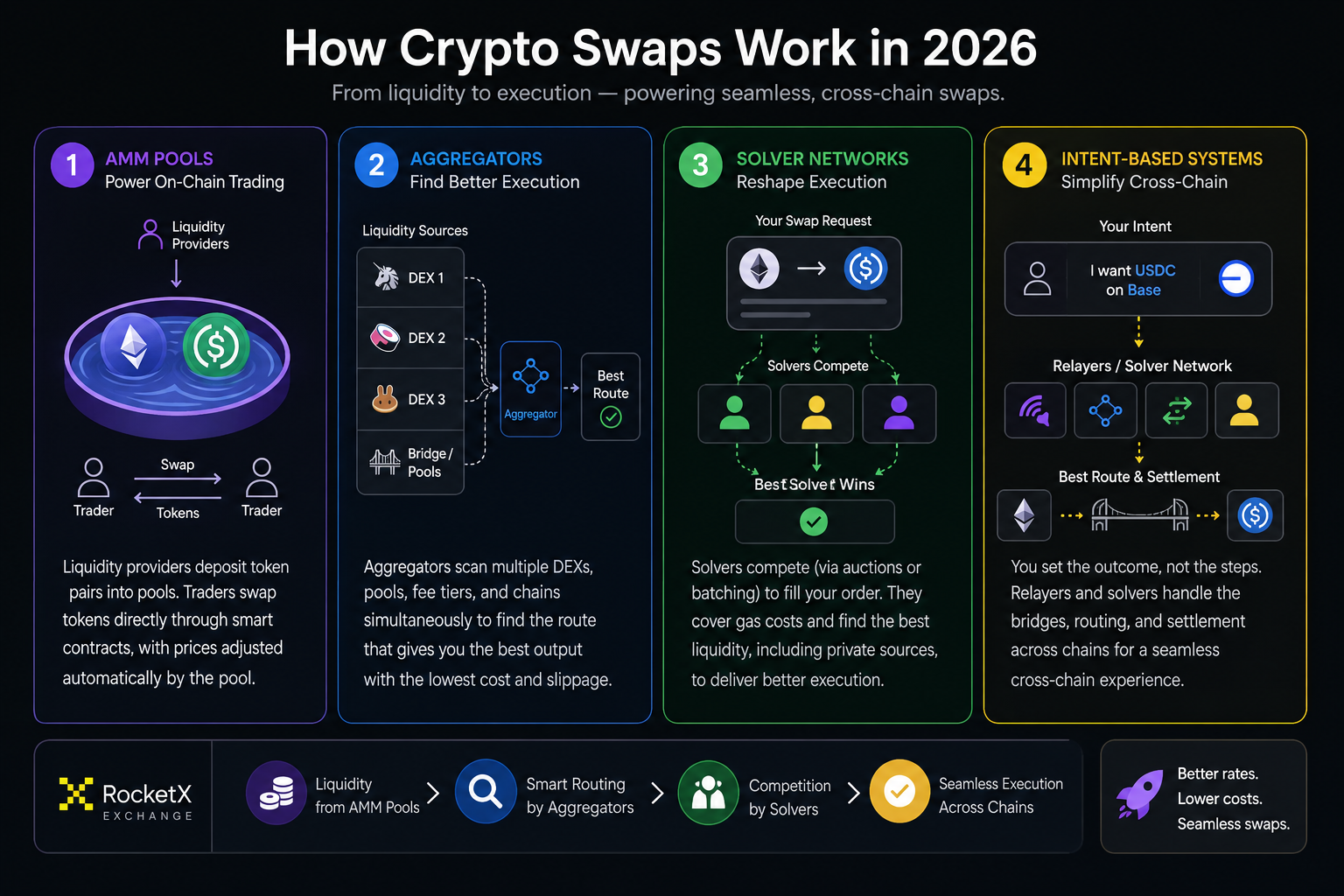
How Crypto Swaps Work in 2026
1. AMM pools remain the foundation of on-chain trading
Despite the rapid evolution of swap infrastructure, a large portion of on-chain trading still relies on Automated Market Makers (AMMs). Protocols like Uniswap allow liquidity providers to deposit pairs of assets into shared pools, enabling traders to exchange tokens directly through smart contracts rather than traditional order books. This model helped make decentralized trading accessible at scale and continues to serve as the backbone of much of the DeFi ecosystem today.
2. Aggregators help traders find better execution
Liquidity is now spread across multiple blockchains, decentralized exchanges, fee tiers, and liquidity pools. As a result, finding the best trade is no longer about choosing a single platform. Instead, execution quality depends heavily on smart routing. Modern aggregators scan numerous liquidity sources simultaneously, compare available paths, and automatically select routes designed to maximize output while minimizing costs, slippage, and inefficiencies.
3. Solver networks and auctions are reshaping execution
Another major development is the growing adoption of solver-based execution models. Rather than users interacting directly with liquidity pools, professional market participants compete to fulfill trades on their behalf. UniswapX uses Dutch auctions where fillers compete for order flow, while 1inch Fusion relies on resolvers that execute trades and cover gas costs. Similarly, CoW Protocol leverages batch auctions and a network of solvers to source liquidity efficiently. These systems can access both public and private liquidity while reducing the complexity users face during execution.
4. Intent-based systems simplify cross-chain transactions
Cross-chain trading is also becoming easier thanks to intent-based execution. Instead of manually defining every step required to move assets between networks, users simply specify the outcome they want. For example, a user may request a particular token on a different blockchain without worrying about the underlying bridge or routing process. Competitive relayers and solver networks then determine the most efficient way to fulfill that request and handle settlement behind the scenes, creating a much smoother user experience.
The Latest Innovations Making Crypto Swaps More Efficient
Intent-based swaps
One of the biggest shifts in crypto trading is the move toward intent-based execution. Instead of forcing users to manually choose crypto bridges, liquidity sources, and routing paths, these systems focus on the desired outcome. Users simply specify what they want to receive, while professional solvers, relayers, or fillers handle the complexity behind the scenes. The result is a smoother experience, fewer manual decisions, and greater flexibility in sourcing liquidity. Platforms such as Across, UniswapX, 1inch Fusion, and CoW Protocol are helping drive this transition toward outcome-focused trading.
Gasless execution
Gasless execution does not eliminate transaction costs. Rather, it removes the need for users to hold a network’s native gas token before initiating a swap. In systems like UniswapX, third-party fillers submit transactions on-chain and cover the gas fees on behalf of users. Similarly, 1-inch Fusion relies on competing resolvers that execute orders while absorbing associated gas costs. This approach significantly improves usability, particularly for users who want to exchange assets without first purchasing ETH, BNB, SOL, or another native token.
MEV-resistant order routing
MEV continues to be one of the most overlooked expenses in on-chain trading. Since transactions are typically visible in public mempools before confirmation, they can become targets for frontrunning, sandwich attacks, and other forms of value extraction. To address this issue, many modern swap protocols are adopting private order flow, auction-based execution, and intent-driven routing models. According to Uniswap and CoW Protocol, these mechanisms can help reduce MEV exposure while improving overall execution quality for traders.
Signature-based approvals and improved permissions
Token approvals are a critical part of the swapping process, yet they often receive far less attention than pricing or liquidity. Traditional unlimited approvals can remain active indefinitely, creating unnecessary security risks. New solutions such as Uniswap’s Permit2 introduce signature-based permissions, temporary approvals, and simplified revocation tools that give users greater control over token access. By reducing reliance on permanent allowances, these systems improve both convenience and wallet security.
Smart wallets and account abstraction
The wallet experience is also becoming more sophisticated. Through ERC-4337 account abstraction, features such as sponsored transactions, custom spending rules, and token-based fee payments are becoming possible without modifying Ethereum’s core protocol. Powered by components like UserOperations, bundlers, and paymasters, smart wallets are making crypto interactions feel increasingly seamless. For everyday users, this translates into simpler onboarding, one-click swaps, and a more streamlined transaction experience across multiple networks.
How to Swap Smarter in 2026
Successful crypto swapping isn’t about chasing the next trending token. More often, it’s about making better execution decisions. The way you route a trade, manage costs, and reduce risk can have a bigger impact on your outcome than the asset itself. Here are some practical principles to keep in mind.
1. Understand the Type of Transaction You Need
Before initiating any transaction, identify whether you need a simple token swap, a bridge transfer, or a cross-chain swap. If you’re exchanging assets on the same network, a standard swap is usually sufficient. If you’re moving funds between blockchains while keeping the same asset, a bridge may be the better option. If you’re changing both the asset and the blockchain, you’ll need a cross-chain swap. Using the wrong method can increase costs, add unnecessary complexity, and create additional points of failure.
2. Focus on What You Actually Receive
The best quoted rate doesn’t always translate into the best result. Network fees, bridge costs, withdrawal charges, and slippage can all reduce the amount that ultimately arrives in your wallet. That’s why experienced traders evaluate the final output rather than the advertised exchange rate. Platforms like RocketX take this approach by comparing routes based on the estimated destination value after accounting for relevant transaction costs.
3. Trade Where Liquidity Is Strong
Liquidity plays a major role in execution quality. Pools with limited liquidity are more susceptible to price impact, wider spreads, and MEV-related losses. Deeper liquidity generally leads to more stable pricing and smoother execution, particularly for larger transactions. Whenever possible, prioritize established liquidity hubs over smaller pools that may struggle to absorb larger orders efficiently.
4. Set Sensible Slippage Limits
Slippage settings require balance. A tolerance that’s too high can expose you to unfavorable execution and increase the risk of sandwich attacks. On the other hand, setting it too low may cause transactions to fail during periods of volatility. The goal is to choose a setting that offers protection while still allowing the trade to execute reliably under current market conditions.
5. Consider MEV-Protected Execution for Large Trades
As trade size increases, execution quality becomes increasingly important. Modern swapping solutions often use solver networks, private order flow, batch auctions, or Dutch auction mechanisms to improve outcomes. These systems can reduce exposure to public mempools, limit MEV-related losses, and help traders achieve better overall execution than traditional routing methods.
6. Double-Check Chains and Token Contracts
Many costly mistakes occur before a trade is even executed. Selecting the wrong network, interacting with an incorrect token contract, or using an unsupported asset version can result in lost funds or failed transactions. This is particularly important when dealing with stablecoins, wrapped assets, or tokens that exist in multiple versions across different blockchains. Always verify the details before confirming a transaction.
7. Send a Test Transaction When Moving Large Amounts
Even experienced crypto users make mistakes. Address-poisoning attacks and look-alike wallet addresses have become increasingly common, making it easier to send funds to the wrong destination. A small test transaction can help verify that everything is configured correctly before committing a larger amount. It’s a simple precaution that can prevent expensive errors.
8. Manage Wallet Approvals Carefully
Approvals are often overlooked, but they represent a significant security risk. Many wallet-draining attacks rely on users unknowingly granting permissions to malicious contracts rather than exploiting the wallet itself. Whenever possible, use time-limited or signature-based approvals and periodically review existing permissions. Revoking access that is no longer needed is one of the easiest ways to improve wallet security.
Where RocketX Fits in the Modern Swap Stack
As the crypto ecosystem becomes increasingly fragmented across blockchains, exchanges, and liquidity sources, finding the best route for a swap has become a challenge in itself. This is where RocketX positions itself—not as another exchange, but as a self-custodial aggregation and routing layer designed to simplify cross-chain trading.
RocketX connects users to liquidity from more than 500 centralized and decentralized exchanges across 200+ blockchains, allowing them to swap virtually any token on any supported chain through a single interface. Rather than relying on a single liquidity source, its smart order routing engine scans available routes and uses years of transaction data to identify the most efficient execution path based on factors such as pricing, speed, and reliability.
One of RocketX’s key differentiators is its hybrid aggregation model. By integrating exchange partners through APIs, the platform can compare opportunities across both CEX and DEX liquidity without requiring users to manually navigate multiple platforms. This helps reduce the complexity of cross-chain transactions while allowing users to maintain control of their assets throughout the process.
RocketX also offers optional privacy-focused routing through private swaps and access to intent-based execution through selected partners. In cases where users choose CEX-based routing, transactions can avoid public mempool exposure, reducing the risk of common MEV-related issues such as front-running and sandwich attacks. The platform further leverages historical execution data gathered from over one million completed swaps and more than $2 billion in transaction volume to improve route selection and provide more accurate estimates for execution time and outcomes.
For newer users, RocketX simplifies what can otherwise be a complicated multichain experience. For experienced traders, it serves as a powerful route-discovery tool that helps compare execution paths across a broad range of liquidity sources. Combined with support for virtually any token on any chain and an optional privacy layer, RocketX occupies a unique position within the evolving 2026 swap landscape.
Final Thoughts
In 2026, a crypto swap is about much more than exchanging one token for another. Behind every transaction is a complex network of liquidity sources, crypto aggregators, bridges, solver networks, stablecoin corridors, and wallet approvals working together to determine the final outcome. The traders who consistently get the best results are not simply looking for the highest quoted rate—they are paying attention to net returns, execution quality, security, and overall efficiency.
By approaching swaps with that mindset, you can avoid costly mistakes, reduce the impact of hidden fees, and navigate the increasingly multichain crypto ecosystem with greater confidence and control.
FAQs
- What is a crypto swap?
A crypto swap is the process of exchanging one cryptocurrency for another. It can occur on the same blockchain or across multiple blockchains through cross-chain swap infrastructure. - What is the difference between a swap and a cross-chain swap?
A standard swap exchanges tokens on the same network, while a cross-chain swap allows users to exchange an asset on one blockchain for a different asset on another blockchain. - Why is swap routing important in 2026?
Liquidity is spread across many chains and exchanges, making routing critical. Smart routing helps traders find better prices, reduce fees, minimize slippage, and improve overall execution quality. - What hidden costs should I consider when swapping crypto?
Beyond the quoted exchange rate, traders should account for gas fees, slippage, bridge costs, liquidity depth, and MEV-related losses, all of which can affect the final amount received. - How does RocketX help improve crypto swaps?
RocketX aggregates liquidity from hundreds of centralized and decentralized exchanges, helping users compare routes and find efficient cross-chain swap opportunities while maintaining self-custody of their assets.
MOST POPULAR ON-CHAIN CRYPTO SWAPS
Video Tutorials on ON-CHAIN CRYPTO SWAPS
Here are a select few popular video tutorials on how to economically and easily do smart on-chain crypto swaps via the Hybrid and decentralized platform – RocketX Exchange.