Key Takeaways
- Bridge to the Canton Network with RocketX: Access Canton from 200+ supported blockchain networks through RocketX’s multi-chain bridging infrastructure.
- Simplify cross-chain access: Find available routes into Canton through one platform instead of searching for a separate bridge for every network.
- Understand Canton’s architecture: Canton uses DAML-based smart contracts and a privacy-focused ledger model rather than a conventional EVM architecture.
- Explore institutional blockchain infrastructure: Canton is designed to support tokenized assets, stablecoins, payments, collateral mobility, and institutional settlement.
- Learn about Canton Coin (CC): Understand its role in the network and its relationship with the Global Synchronizer.
- Understand cross-chain transfers: Learn how source networks, supported assets, destination wallets, and available liquidity affect bridging into Canton.
- Discover Canton’s interoperability layer: Explore how the Global Synchronizer connects applications while supporting Canton’s privacy-focused architecture.
- Choose the right bridging route: Check asset compatibility, estimated fees, receive amounts, and transaction times before confirming a transfer.
Introduction
Canton Network is becoming an important part of the blockchain infrastructure being built for institutional finance, tokenized assets, stablecoins, and privacy-focused transactions.
But there is a practical question for crypto users that often gets overlooked: If your assets are already on Ethereum, Base, Solana, BNB Chain, or another blockchain, how do you get them into Canton?
The answer is different from using a traditional EVM-compatible blockchain. Canton uses its own DAML-based architecture and privacy model, which means wallets, assets, and cross-chain transfers work differently from networks such as Ethereum or Arbitrum.
This guide explains what Canton Network is, how it works, why it is attracting institutional activity, how assets can move into the ecosystem, and how a multi-chain platform such as RocketX can provide access to Canton from supported networks.
What Is Canton Network?
Canton Network is a public blockchain network designed specifically to connect financial applications and digital assets while preserving privacy and control.
Unlike many public blockchains where transaction information is broadly visible, Canton uses a privacy-oriented architecture in which participants only see the transaction information relevant to them. This model is designed to address one of the major requirements of institutional finance: organizations need interoperability and shared settlement infrastructure without exposing commercially sensitive information to everyone on a public ledger.
Canton describes itself as a public chain with privacy and positions the network around capital markets, tokenized assets, payments, and institutional finance. Its current ecosystem includes applications and infrastructure involving banks, financial institutions, exchanges, custodians, and other market participants.
Canton’s Global Synchronizer provides the interoperability layer that allows independent applications and networks to coordinate transactions while retaining their own privacy and control. Canton says the infrastructure is designed to support atomic transactions across independent blockchains and applications.
Why Is Canton Network Different From Ethereum?
One of the most important things to understand before using Canton is that Canton is not simply another EVM-compatible chain.
Ethereum uses the Ethereum Virtual Machine and supports a large ecosystem of EVM wallets, applications, smart contracts, and development tools.
Canton instead uses the DAML smart contract language and its own ledger and privacy architecture.
|
Feature |
Canton Network |
Ethereum |
|
Architecture |
Daml-based |
EVM-based |
|
Primary focus |
Institutional finance and interoperable financial applications |
General-purpose blockchain |
|
Privacy |
Privacy built into transaction architecture |
Transactions generally publicly observable |
|
Smart contracts |
Daml |
Solidity and other EVM languages |
|
Institutional use |
Core network focus |
Broad ecosystem |
|
Interoperability |
Global Synchronizer and Canton ecosystem |
Ethereum ecosystem and external bridges |
This difference matters most when moving assets between Canton and other blockchains.
A user cannot simply treat Canton like another EVM network, add a network RPC to MetaMask, and assume that every Ethereum token can be transferred directly.
Canton’s documentation and ecosystem resources emphasize that its ledger model and wallet infrastructure differ from conventional EVM networks.
Why Are Users and Institutions Moving Assets to Canton?
Canton’s appeal goes beyond its native token.
The network is being developed around financial use cases such as
- Tokenized real-world assets
- Stablecoins and digital cash
- Collateral mobility
- Institutional settlement
- Tokenized securities
- Payments
- Privacy-preserving financial applications
- Cross-application financial workflows
Canton says more than $350 billion in assets are processed on the network daily, while its ecosystem is expanding around tokenized financial assets and institutional applications.
Its recent ecosystem developments also show how strongly the network is targeting traditional financial infrastructure. Canton highlights work involving tokenized U.S. Treasuries, institutional settlement, collateral mobility, and tokenization infrastructure.
For example, Canton announced that Ledger added support for Canton Coin and privacy-enabled assets in August 2026, while the network is preparing for the launch of DTCC’s Tokenization Service.
The network is therefore becoming relevant to a wider range of users who may already hold assets outside Canton but want access to applications and assets within its ecosystem.
What Is Canton Coin (CC)?
Canton Coin, commonly represented as CC, is the native utility token associated with Canton’s Global Synchronizer.
It is used to pay for activity on the Global Synchronizer and is part of the network’s incentive model for application builders, users, and infrastructure providers.
However, CC is not the only asset that matters within the Canton ecosystem.
Canton supports multiple token standards and assets, including privacy-enabled assets and stablecoins. For example, USDCx is available on Canton, while other tokenized assets are being developed for institutional and financial applications.
This distinction matters when considering a cross-chain transfer because the asset you start with and the asset you receive do not necessarily have to be the same.
How Does Bridging to the Canton Network Work?
Bridging into Canton is different from moving an ERC-20 token between two EVM networks.
At a high level, the process looks like this:
Source blockchain → Cross-chain route → Canton-compatible asset → Canton wallet/application
The exact mechanism depends on:
- The blockchain where your assets currently reside
- The asset you want to transfer
- The available bridge or routing infrastructure
- The destination asset supported on Canton
- The Canton wallet or application you use
For example, a bridge may allow USDC on Ethereum to be transferred into a Canton-native representation or another supported asset.
Dedicated Canton infrastructure providers are already building these routes. Temple’s bridge, for example, supports transfers from Ethereum and Base and currently supports selected assets, including USDC and ETH, into Canton.
More recently, OneSwap launched a Canton bridge connecting Ethereum, Base, Arbitrum, BNB Chain, Polygon, Optimism, Avalanche, and Linea with Canton. The initial launch supports selected assets, including USDC, USDT, ETH, BNB, POL, and AVAX, depending on the route.
This shows an important trend: Canton’s cross-chain connectivity is expanding, but available routes still depend on the source network, asset, and bridge infrastructure.
How to Bridge Assets to the Canton Network with RocketX
RocketX supports Canton Network, allowing users to bridge assets from supported blockchain networks into Canton through its multi-chain platform. The process follows the same straightforward steps used for other cross-chain swaps on RocketX: connect your wallet, select your source network and asset, choose Canton as the destination, review the quote, and confirm the transaction.
1. Connect Your Wallet
Visit RocketX and connect the wallet that holds your assets on the source blockchain. Use a wallet compatible with your source network, such as MetaMask for supported EVM networks or Phantom for Solana.
You will also need a Canton-compatible destination wallet to receive and access your assets on Canton. Confirm that your wallet supports the destination asset before starting the transfer.
2. Select the Source Network and Asset
Choose the blockchain where your funds are currently held, then select the asset you want to bridge. For example, you might select USDC on Ethereum or an asset on another supported network.
3. Select Canton Network as the Destination
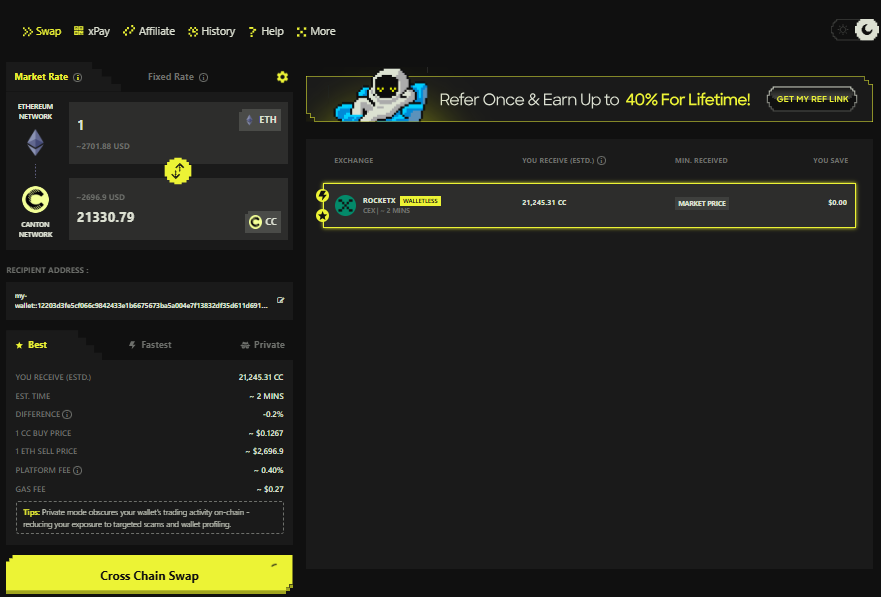
Choose Canton Network as your destination. RocketX will display the available route and quote for your selected source network and asset.
4. Enter the Amount
Enter how much you want to transfer. Review the quoted exchange rate, applicable fees, estimated receive amount, and transaction time before proceeding.
5. Review and Confirm the Transaction
Check the transaction details carefully, including the destination asset and any wallet or recipient information required by the route. Once you are satisfied with the quote, approve the transaction using your connected source wallet.
6. Receive Your Assets on Canton
After the transfer completes, access the received asset through the compatible Canton wallet or application specified for the transaction. Completion time can vary depending on the route and network conditions.
A Multi-Chain Route Into Canton
If you already hold crypto across multiple blockchains, accessing Canton should not require you to search manually for a separate bridge for every network.
RocketX supports Canton Network and provides a single interface for exploring cross-chain routes from its supported blockchain ecosystem. With support for 200+ blockchain networks and liquidity aggregated across 500+ centralized and decentralized exchanges, RocketX helps users find available routes into Canton from the networks where they already hold assets.
Instead of navigating multiple platforms, users can select their source network and asset, choose Canton as the destination, and review the available quote through RocketX.
This makes RocketX a practical option for users who want to access the Canton ecosystem while managing assets across different chains. Before confirming a transfer, always review the available route, destination asset, fees, and receive amount. Actual availability depends on the selected asset and route at the time of the transaction.
Canton Bridge vs. Buying CC on an Exchange
There are several ways a user can gain access to Canton assets.
|
Method |
Starting Point |
Cross-Chain Access |
CEX Required |
|
Buy CC on a CEX |
Fiat or crypto |
No |
Usually |
|
Withdraw CC |
Existing CC balance |
No |
Depends on source |
|
Dedicated bridge |
Selected supported assets |
Yes |
No |
|
Multi-chain aggregator |
Assets on supported networks |
Yes |
Not necessarily |
Buying CC on an exchange can make sense when your objective is simply to acquire Canton Coin. But users who already hold crypto on another blockchain may prefer to investigate a cross-chain route instead of selling the asset, purchasing CC separately, and then withdrawing it to a Canton wallet.
The right option depends on the asset, destination use case, fees, liquidity, and available routes.
What Wallet Do You Need for Canton Network?
Canton does not work like a standard EVM network. Many traditional EVM wallets cannot simply be used as native Canton wallets. Canton-specific wallet infrastructure has therefore become an important part of the ecosystem. Canton-focused wallet guides currently list options such as Zoro, Bron, and C8 Wallet, while Ledger announced Canton Coin and privacy-enabled asset support in August 2026.
Before transferring funds, always verify that your destination wallet supports the specific Canton asset you are receiving.
Frequently Asked Questions
What is Canton Network?
Canton Network is a public blockchain network designed for privacy-preserving financial applications, tokenized assets, interoperability, and institutional finance.
Is Canton Network an EVM chain?
No. Canton uses a DAML-based architecture rather than operating as a conventional Ethereum Virtual Machine blockchain. This affects its smart contracts, wallets, transaction model, and cross-chain infrastructure.
What is Canton Coin?
Canton Coin (CC) is the native utility token associated with the Global Synchronizer. It is used for network activity and helps incentivize applications and infrastructure that provide utility to the Canton ecosystem.
Can I bridge assets to Canton Network?
Yes, cross-chain infrastructure now provides routes from selected public blockchains into Canton. Available networks and assets depend on the specific bridge or routing platform.
Can I bridge USDC to Canton?
Yes. Users can bridge USDC to the Canton Network through RocketX when a compatible USDC route is available for the selected source network.
This allows users holding USDC on a supported blockchain to look for a route into Canton without first having to move their funds through a centralized exchange.
Can I bridge Ethereum to Canton?
Yes. RocketX supports ETH-to-Canton bridging where a compatible route is available.
Users can select Ethereum as the source network, choose ETH as the asset, select Canton as the destination, and review the available route, receive amount, fees, and estimated transaction time before confirming the transaction.
Can I bridge from Base to Canton?
Yes. Base is supported for Canton bridging through RocketX. Users can select Base as their source network and Canton as the destination to check the available cross-chain route.
Can I bridge from any blockchain to Canton?
Not necessarily. The route must be supported by the selected bridge or aggregator, and the required asset and liquidity must be available. A multi-chain aggregator can broaden the number of possible source networks, but availability should always be checked before initiating a transaction.
What is the Global Synchronizer?
The Global Synchronizer is Canton’s interoperability infrastructure. It is designed to connect applications and independent networks while maintaining privacy, control, and support for atomic transactions.
Why is Canton Network important?
Canton is focused on bringing blockchain infrastructure into institutional financial markets, including tokenized assets, stablecoins, collateral mobility, payments, and settlement. Its ecosystem includes infrastructure and financial institutions working on real-world financial applications.
Final Thoughts
Canton Network is developing a different approach to blockchain interoperability.
Rather than treating every financial transaction as publicly visible activity on a general-purpose chain, Canton is designed around privacy, controlled access, interoperability, and institutional financial applications.
That makes access to the network increasingly important as more tokenized assets, stablecoins, and financial applications move onto Canton.
For users who already hold assets elsewhere, however, the practical question remains: how do you get those assets into Canton?
Dedicated bridges are expanding the number of available routes, while multi-chain aggregators can simplify access across a wider range of supported networks.
RocketX provides one such multi-chain access layer, allowing users to connect to supported networks, compare available routes, and bridge assets toward Canton, where a compatible route and liquidity are available.
As Canton continues expanding its institutional and digital-asset ecosystem, cross-chain connectivity will become an increasingly important part of how users access it.